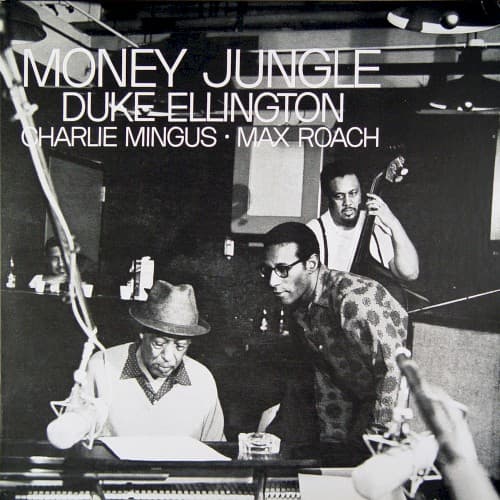
The scorecard
8.0/10 · Great
- Composition20%
- 8.5
- Recording15%
- 6.0
- Performance30%
- 9.0
- Cohesion15%
- 7.0
- Originality10%
- 8.0
- Replay value10%
- 8.5
Four original compositions written for the session plus three reimagined standards, all with harmonic frameworks sturdy enough to support three strong improvisers pulling in different directions.
The three-track tape captures the interplay but the piano microphone peaks on the loudest chords and the stereo spread isolates the bass too far right and drums too far left.
Mingus bends strings until the bass sounds like a berimbau, Roach layers polyrhythms without losing the pulse, and Ellington plays more dissonant chords and riskier lines than on any other trio date.
The original seven tracks sequence well from the blues opening through two ballads to the closing solo statement, but the session produced no obvious filler and the later CD additions feel arbitrary rather than curated.
The post-bop language was current in 1962 but the combination of Ellington's orchestral piano voicings with Mingus and Roach's modernist rhythm section had not been attempted before and has rarely been matched since.
The contrapuntal push and pull rewards repeated listens as details emerge: Mingus answering Ellington's left hand, Roach shifting the time feel mid-chorus, the three voices weaving without a score.
Duke Ellington Money Jungle — When the Master Met the Modernists
Money Jungle proves that Duke Ellington could improvise as boldly as the younger generation when the rhythm section forced him to. Recorded in a single afternoon in September 1962 with Charles Mingus and Max Roach, the album strips Ellington down to piano trio and pushes him into harmonic territory he rarely visited on his big band dates. Mingus plucks the strings with such force that the bass sounds like a Delta blues guitar bent out of shape, and Roach answers with polyrhythms that never settle into the swing-era ride cymbal patterns Ellington knew best. The result is a post-bop session that sounds like three musicians negotiating in real time rather than executing a rehearsed arrangement.
The stakes are higher than the usual piano trio date because Ellington was 63 and between recording contracts while Mingus and Roach were in their late thirties and signed to United Artists. Producer Alan Douglas gave them lead sheets and no rehearsal, so the first take was the first time they played these pieces together. Four of the seven original LP tracks were written specifically for the session, including the title blues and the angular Wig Wise, and Ellington brought reimagined charts for Caravan and two of his ballads. What could have been a respectful tribute to an elder statesman instead became a contest, with Mingus pushing Ellington toward dissonance and Roach fragmenting the time feel until the pianist had to dominate both of them just to hold the tunes together. The tension is audible, especially on the title track where Ellington lays down dissonant chords over Mingus bending notes and Roach firing snare accents, and the session nearly collapsed mid-date when Mingus briefly walked out. But the music that survived is some of the most forceful piano playing Ellington ever recorded.
Three Voices, No Arrangement
Money Jungle works because the three players are too strong to defer to one another. Ellington brings the compositions but Mingus and Roach treat the lead sheets as suggestions, adding countermelodies and shifting the harmonic rhythm until the pianist has to fight for space. On the title track Mingus opens with heavily plucked notes that set a blues frame, then Ellington enters with dissonant chords that clash deliberately rather than resolve. Roach supports with ride cymbal, snare and bass drum but never settles into a straight four, and in the final minute Mingus bends the strings with enough force to make the instrument sound like a cross between a berimbau and a Delta blues guitar. The interplay is contrapuntal rather than supportive: three voices stating independent lines that happen to land together.
Ellington recorded the session on three-track tape at Sound Makers Studios in New York, with producer Alan Douglas overseeing. The piano sits up front and center, the bass is isolated far to the right channel, and the drums are strictly in the left channel and slightly behind the piano. The stereo spread clarifies the three voices but it also exposes the limits of the recording: the piano microphone peaks on the loudest chords and the overall sound is disappointingly woolly compared to the Rudy Van Gelder recordings Mingus and Roach were making for other labels. The distortion is most noticeable on Money Jungle and Caravan, where Ellington hammers the keys in low octaves.
The writing gives the improvisers enough structure to improvise against without locking them into big band arrangements. Fleurette Africaine, one of four compositions written for the session, develops from a simple melody stated on piano and features Mingus floating a bassline underneath while Roach underplays with brushes and mallets. Very Special is a 12-bar blues, possibly improvised on the spot, where Mingus adds countermelodies and answers to what Ellington plays rather than walking a steady line. Wig Wise, another original, is built on an angular descending line that Ellington voices in clusters while Mingus and Roach fragment the pulse. On Caravan, Ellington plays the melody in low octaves and adds Webern-like notes on top, imitating an orchestral sound with just the piano, and Mingus and Roach respond by pushing the tempo until the arrangement barely holds.
The weakness is that Ellington did not leave room for the others to contribute their own compositions despite telling them the day before to bring material. According to the accounts in the fact sheet, Mingus expected a collaborative session and walked out mid-date when he felt the playing was not honest, though Ellington coaxed him back and the session finished. The tension is productive on the uptempo numbers but on Warm Valley and Solitude, two older ballads, Mingus either does not know the changes or is deliberately undermining them. Warm Valley in particular sags in the middle when the bass wanders off the form and Roach drops out entirely for stretches, and the track feels like a concession to get through the session rather than a planned performance.
Tension and Release Across Seven Pieces
The original seven-track LP builds from confrontation to resolution, with the combative title blues opening and a closing solo statement. The sequencing earns the length by varying the energy across three modes: uptempo pieces where all three players compete for dominance, ballads that give space for quieter interplay, and midtempo compositions where Ellington reasserts his orchestral voicings. The pacing works because the album never tries to sustain the high tension of the opening track for the full half-hour.
The later CD reissues add eight tracks from the same session, including alternate takes and four more compositions. The additional slow blues reveals Mingus virtuosity with a looseness that puts feeling before precision, and the Latin-influenced feature for Roach breaks up the piano-bass interplay. But the additional material dilutes the original arc rather than extending it, and the expanded CD feels more like a document of the session than a curated album. The alternate takes add little beyond proof that the musicians could play the same piece twice with minor variations, and the longest addition runs over six minutes without developing its reversed blues structure into anything more than an exercise.
Where It Ranks and Who Should Start Here
Money Jungle is the most modern piano recording Ellington made and one of the few times he submitted fully to the post-bop language his younger peers were developing. It ranks among the essential Ellington albums not because it represents his big band legacy but because it proves he could hold his own against Mingus and Roach when stripped of arrangements and forced to improvise in real time. The album is for listeners who want to hear Ellington as a pianist rather than as a bandleader, and for anyone interested in how the swing era and the post-bop generation negotiated shared ground. It has aged well because the contrapuntal interplay still sounds fresh sixty years later, with details emerging on repeat listens as Mingus answers Ellington left hand and Roach shifts time feel mid-chorus.
Skip this if you want polished big band Ellington or if you expect a relaxed piano trio date in the Bill Evans mode. The interplay here is combative rather than conversational, and the rhythm section pushes Ellington into dissonance and fragmentation that some will hear as tension and others will hear as three musicians working at cross purposes. The production is also a limitation: the woolly sound and peaky piano distortion detract from the music, and the later CD expansions add session outtakes that belong in an archive rather than on a streamlined album.
Start with Money Jungle, Fleurette Africaine and Wig Wise to hear the core of what makes the session essential. If those three tracks work for you, Caravan and Very Special extend the same combative interplay, and Solitude shows Ellington reasserting control at the end. For the next step, hear Mingus Ah Um to understand what Mingus brought to the session, and hear any of the Ellington big band albums from the 1940s to understand what Ellington left behind when he agreed to the trio format. Money Jungle is not a career pinnacle but it is an essential document of what happened when the master met the modernists and nobody backed down.
Track by track
Track Listing
Money Jungle
StandoutThe title track opens with Mingus plucking heavily and Ellington entering with dissonant chords that refuse to resolve into swing-era harmony. Roach supports with ride cymbal, snare and bass drum but never settles into a straight four, layering polyrhythms that fragment the pulse without losing the blues form. The tension builds across five minutes as all three players compete for dominance, and in the final minute Mingus bends the strings with such force that the bass sounds like a cross between a berimbau and a Delta blues guitar. The interplay is contrapuntal rather than supportive, with three independent voices that happen to land together on the downbeats. This is the apex of the session combative energy and the track that best represents what makes the album essential.
Les Fleurs Africaines (African Flower)
StandoutEllington states a simple melody on piano and develops it across three minutes with Mingus floating a bassline underneath and Roach underplaying with brushes and mallets. The ballad is one of four compositions written specifically for the session and it gives the trio space for quieter interplay after the combative opening. Mingus trills on the main motif and wanders both away from and in response to Ellington refrain, and Roach cool inchoate rumblings glide beneath without imposing a fixed tempo. The track is a forerunner of the free ballad style that Keith Jarrett and others would develop in the 1970s, with a group dynamic that relies on listening rather than arrangement.
Very Special
StandoutA 12-bar blues, possibly improvised on the spot, where Mingus adds countermelodies and answers to what Ellington plays rather than walking a steady bassline. The interplay is forceful and the track showcases how all three musicians push one another into riskier choices than they would make in more predictable settings. Roach fragments the time and Ellington voices chords in clusters that clash deliberately. At four and a half minutes the track earns its length by varying the texture: piano and bass trade phrases in the first chorus, Roach enters with snare accents in the second, and the final minute builds to a collective improvisation where all three voices compete. A strong example of the session post-bop language.
Warm Valley
WeakAn older Ellington ballad that sags in the middle when Mingus wanders off the form and Roach drops out entirely for stretches. The track feels like a concession to get through the session rather than a planned performance, and the interplay lacks the focus of Fleurette Africaine or the combative energy of the blues numbers. Ellington plays the melody with orchestral voicings but the rhythm section does not support him, and the result is three and a half minutes that drag rather than develop. The Penguin Guide to Jazz suggests Mingus either did not know the changes or was disgruntled, and the playing supports that reading.
Wig Wise
StandoutBuilt on an angular descending line that Ellington voices in clusters while Mingus and Roach fragment the pulse, this is one of four compositions written for the session and it showcases the post-bop harmonic language Ellington was exploring. The melody is dissonant and the rhythm section refuses to settle into a groove, with Mingus plucking countermelodies and Roach layering snare and bass drum accents that shift the time feel every few bars. At three minutes the track is concise and focused, and it ranks among the strongest performances on the album for the way all three musicians improvise against the structure rather than executing it.
Caravan
SolidEllington plays the melody in low octaves and adds Webern-like notes on top, imitating an orchestral sound with just the piano. Mingus and Roach respond by pushing the tempo until the arrangement barely holds, and the track becomes a contest between Ellington trying to maintain his big band voicings and the rhythm section trying to break them apart. The interplay is combative and the result is one of the most forceful renditions of the standard, though the Penguin Guide to Jazz claims it is a relatively weak version compared to the big band recordings. The piano microphone peaks on the loudest chords and the distortion detracts from the performance.
Solitude
StandoutEllington plays the ballad as a piano solo for four minutes, stating the melody with orchestral voicings and developing it without rushing. Mingus and Roach enter only in the final minute, adding bass and brushes that support rather than challenge the pianist. The track functions as an epilogue where Ellington reasserts control after the combative interplay of the previous six pieces, and the sequencing works because the album needed a resolution. At five and a half minutes the track earns its length by giving Ellington space to play without negotiating with the rhythm section, and the final minute where all three voices converge feels like a deliberate choice to end on shared ground rather than contest.