The scorecard
8.9/10 · Essential
- Composition20%
- 9.5
- Recording15%
- 7.5
- Performance30%
- 9.0
- Cohesion15%
- 8.5
- Originality10%
- 9.0
- Replay value10%
- 9.5
The compositions range from gospel-derived structures to elegiac ballads to pointed political statements, each with a distinct framework that gives the soloists real material to work with.
The Columbia 30th Street Studio sessions capture the band clearly, but the edited versions that dominated for decades and the occasionally uneven balance between horns and rhythm section keep this from perfect documentation.
The ensemble plays with absolute commitment across every mood, from the fervent preaching of the opener to the delicate voicings on the Ellington tribute, with Ervin and Handy delivering solos that serve the compositions rather than hijacking them.
Nine tracks, nine subjects, held together by Mingus' bass and a shared vocabulary of tribute and protest; the sequencing moves logically from declaration to elegy to dance, though the breadth of reference occasionally strains against album unity.
Mingus synthesized hard bop, gospel, swing and classical voicings into something that sounded like none of his contemporaries in 1959, making tribute sound forward rather than nostalgic.
Every return reveals new details in the orchestration and new connections between the tribute pieces; the album has aged into essential listening precisely because it addressed its moment without sounding trapped in it.
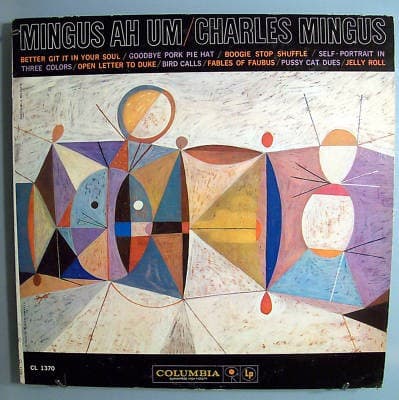
Charles Mingus Mingus Ah Um — Tribute as Argument, Not Nostalgia
The question with tribute albums is whether they honor the past or hide in it. Mingus Ah Um does neither: it argues with its ancestors, using their vocabulary to say things they had not said.
The opening track announces this from the first note. "Better Git It in Your Soul" sounds like a gospel service transplanted to a nightclub, Mingus shouting exhortations over a riff that swings hard enough to profane the sacred and sanctifies the profane in return. It is not respectful. It takes what Mingus heard in church as a child and makes it into a vehicle for jazz improvisation that refuses to sit still or behave.
That refusal runs through the whole album: tributes to Lester Young, Duke Ellington, Jelly Roll Morton and Charlie Parker that sound like Mingus rather than imitations, political protest disguised as a fable, and a self-portrait written for a film that never used it. The thread is Mingus himself, his bass and his compositional voice turning nine separate ideas into a single statement about what jazz could carry in 1959.
This was Mingus' first album for Columbia, recorded in two sessions in May 1959 at the label's 30th Street Studio. The band was a working unit: Booker Ervin and John Handy on reeds, Jimmy Knepper or Willie Dennis on trombone depending on the date, Horace Parlan on piano, Dannie Richmond on drums. Columbia's producer Teo Macero edited six of the nine tracks for the original LP release, cutting between one and three minutes from each to fit the format and because he thought the pieces worked better shorter. The unedited versions were not widely available until 1998.
The edits matter: they change the arc of several performances and remove improvisation that earns its length. But even in the truncated form that most listeners heard for nearly forty years, the album made its case.
The Workshop Method on a Major Label
Mingus built these compositions the way he had been building them in his Jazz Workshop ensembles: written themes, specific voicings, structures that allowed for improvisation within clear boundaries, and bass lines that functioned as both foundation and commentary. The writing is the album's greatest strength. Each piece has a distinct character and a framework that gives the soloists something to respond to rather than just changes to blow over. "Goodbye Pork Pie Hat," the elegy for Lester Young, is built on a melody so deliberate and mournful that it dictates the mood of every solo that follows. "Boogie Stop Shuffle" sets up a twelve-bar blues with four themes and a bass line that shifts from stop time to shuffle and back, forcing the horns to adjust their phrasing with each change. "Open Letter to Duke" draws on three earlier Mingus pieces and revoices them into an Ellington tribute that sounds like Mingus learned the voicings and then bent them.
The arrangements use the horns economically: two or three voices in harmony, occasional unison lines, and space for the rhythm section to be heard clearly. Mingus' bass is present on every track, sometimes walking, sometimes playing countermelodies, sometimes doubling the theme. Parlan's piano comps with a light touch and takes solos that reference stride and bebop without overstating either. Richmond's drums drive the uptempo pieces and recede on the ballads, adjusting to the material rather than imposing a single approach. The two-trombone/two-or-three-saxophone front line allows for a range of textures, from the gospel shout of the opener to the chamber-like delicacy of "Self-Portrait in Three Colors."
The recording captures the band clearly, with the horns forward and the rhythm section audible but sometimes slightly recessed. The 30th Street Studio had good natural reverb, and the sessions used it without overwhelming the direct sound. The balance occasionally favors the melody instruments at the expense of the bass and drums, which matters on an album where the rhythm section does as much structural work as the front line. The edits are the larger production issue. Macero's cuts streamlined some pieces effectively but removed sections of improvisation that were not filler, particularly on "Bird Calls" and "Pussy Cat Dues." The unedited versions restore the full performances, and most of the restored material earns its time.
The weakness is unevenness. Not every track is equally strong. "Jelly Roll" is a pleasant Morton reference with a Parlan solo that quotes Sonny Rollins, but it does not have the weight or the invention of the stronger pieces. "Pussy Cat Dues" meanders in both the edited and unedited versions, a blues that runs long without building much tension. These are not bad tracks, but they are not at the level of "Fables of Faubus" or the Lester Young elegy, and their presence means the album sags slightly in the second half.
From Gospel Shout to Elegy to Protest, a Deliberate Arc
The sequencing moves from assertion to reflection to dance, with the political statement placed two-thirds through as a pivot. The opening track establishes the energy and the approach: gospel-derived, communal, participatory, with Mingus' shouts and handclaps making the listener a witness rather than just an audience. The second track follows as a contrast, slowing the tempo and narrowing the focus to a single melodic idea and the solos it generates. The middle section alternates between tributes and reveal: the boogie-shuffle hybrid, the unused film cue, the Ellington letter, the bird-not-Bird piece.
Each has a different texture and a different compositional idea, which keeps the album from settling into a single mood but also means it does not build momentum in a linear way. The rhetorical center arrives two-thirds through, where tribute turns into protest. The piece was written with lyrics attacking Arkansas Governor Orval Faubus for his opposition to school integration, but Columbia refused to include the words, so the recording is instrumental. Even without the text, the music is agitated and confrontational, a two-part theme that shifts between mockery and anger.
The performance has an edge that the tribute pieces do not. The final two tracks ease the tension: a minor-key blues that runs longer than its ideas support, and a closer that ends the album with a reference to Morton and a lighter mood. The sequence works, though a stronger closer would have balanced the weight of the opener. The album is not a unified suite, but it is a deliberate progression through Mingus' concerns in 1959: ancestry, protest, and the possibilities of composition within jazz.
The Album That Argues for Mingus as Composer First
This is Mingus at the height of his writing, before the larger ensembles and the more ambitious structures of the 1960s and 1970s, but after the apprenticeship. The compositions are consistently inventive, the band is tight, and the album makes a case for jazz as a form that can carry tribute, protest, and autobiography in a single program. It is not flawless: the second half has weaker moments, and the production choices—both the original edits and the occasionally uneven balance—keep it from perfect documentation.
But the strengths are considerable, and the album has aged well precisely because it was specific to its moment without being limited by it. The tributes sound less like nostalgia and more like Mingus claiming a lineage and then using it for his own purposes. The protest piece, even as an instrumental, makes its point. The range of moods and structures shows a composer working at full capacity.
This album is for listeners who want to hear Mingus as a writer and bandleader rather than just a virtuoso bassist. It is also the best entry point into his Columbia period, clearer in its intent and more focused than some of the later, more sprawling sessions. Jazz listeners who prefer small-group swing-to-bop hybrids will find this more accessible than Mingus' more overtly experimental work. Those looking for unrestrained blowing will find the written material too present and the solos too structured.
Start with "Better Git It in Your Soul" for the gospel energy, "Goodbye Pork Pie Hat" for the elegiac side, and "Fables of Faubus" for the protest. If those three tracks hold your attention, the rest of the album will repay close listening. For next steps, the 1961 version of "Fables of Faubus" with the original lyrics on Charles Mingus Presents Charles Mingus shows what Columbia would not allow. The album stands as one of the essential late-1950s jazz records, a demonstration that tribute and innovation were not opposites.
Track by track
Track Listing
Better Git It in Your Soul
StandoutA gospel-service opener with Mingus shouting exhortations over a riff that the horns play in call-and-response patterns. The structure alternates between ensemble passages and solos, with the rhythm section maintaining a relentless swing throughout. Handy and Ervin take saxophone solos that build in intensity without losing the sanctified feel, and the track ends with the same energy it started with. Mingus' bass line is the foundation, a two-note figure that drives the entire performance. The handclaps and shouts are not overdubs: this is the band responding to the music in real time, and the participation makes the track feel like a ritual rather than a composed piece. It remains one of Mingus' most immediately recognizable recordings, and it sets the album's terms: this is tribute that transforms rather than imitates.
Goodbye Pork Pie Hat
StandoutAn elegy for Lester Young, who died two months before the session. The melody is one of Mingus' most affecting: a slow, deliberate theme played by the horns in close harmony, with a bass line that walks quietly beneath it. The composition dictates a mood of reflection and loss, and the soloists—Handy on tenor, then Ervin—play with restraint, staying close to the melody's contour and tone. The track was edited on the original LP release, cutting nearly a minute, but even the shorter version communicates the intent. The unedited version allows the solos more room to develop without rushing. This is Mingus writing at his most disciplined: a single idea, fully realized, with no wasted notes. It has become one of the most-covered Mingus compositions, and the original recording remains definitive.
Boogie Stop Shuffle
StandoutA twelve-bar blues with four distinct themes and a bass line that shifts between stop time and shuffle. The structure forces the horns and the rhythm section to adjust their phrasing with each change, creating tension and release within a familiar form. The solos navigate the shifts smoothly, particularly Ervin's tenor solo, which uses the stop-time sections to punctuate ideas and the shuffle sections to build momentum. The composition is self-referential in the best sense: it names what it does and then does it with enough invention to justify the concept. The original LP edit removed over a minute, tightening the performance but also removing some of the interplay between the soloists and the rhythm section. The full version is stronger, though the edit is defensible.
Self-Portrait in Three Colors
SolidOriginally written for John Cassavetes' film Shadows but unused due to budget constraints. A three-part miniature with distinct sections: a lyrical opening theme, a more agitated middle section, and a return to the opening mood. The piece uses the horns in close voicings, with Mingus' bass providing harmonic and melodic commentary. At just over three minutes, it is the album's shortest track, and it functions as a palette cleanser between the blues of the previous track and the Ellington tribute that follows. The "three colors" of the title are audible in the three distinct textures Mingus uses, though the piece does not develop any of them at length. It is a sketch rather than a full composition, well-executed but minor.
Open Letter to Duke
StandoutA tribute to Duke Ellington built from three earlier Mingus pieces: "Nouroog," "Duke's Choice," and "Slippers." The composition uses Ellington-style voicings and section writing, with the horns trading phrases and the rhythm section playing with a light, swing-era touch. The tribute is affectionate but not deferential: Mingus learned Ellington's techniques and then used them for his own purposes. Parlan's piano solo references stride without quoting it directly, and the trombone work by Willie Dennis adds a warmth that balances the reeds. The original LP version was edited by nearly a minute, removing part of the ensemble interplay at the end. The full version gives the arrangement more room to breathe and makes the Ellington reference clearer. This is one of the album's best tracks, a demonstration that tribute can be a form of compositional invention.
Bird Calls
StandoutMingus stated that this piece was intended to sound like actual birds rather than Charlie Parker, despite the title. The composition uses the horns in high, quick phrases that do suggest birdsong, with Mingus' bass providing a grounding line beneath the flutter. The piece alternates between ensemble sections and solos, with Handy on alto navigating the birdlike figures and then breaking into a more conventional jazz solo. The original LP edit cut this track from over six minutes to just over three, removing most of the solo development and some of the ensemble interplay. The edit turned the track into a novelty; the full version reveals a more substantial composition with real invention in the voicings and the solo sections. The unedited version is essential; the edit is a significant loss.
Fables of Faubus
StandoutA protest piece aimed at Arkansas Governor Orval Faubus, who opposed school integration in Little Rock in 1957. Columbia refused to allow the lyrics Mingus had written, so the album version is instrumental. The composition has a two-part structure: a mocking, almost cartoonish theme and a more agitated, dissonant section. The performance has an edge and an urgency that the tribute pieces do not, with the soloists playing more aggressively and the rhythm section pushing harder. Knepper's trombone solo is particularly pointed, using the instrument's capacity for both lyricism and growl. Even without the words, the music communicates anger and confrontation. The 1961 version with the original lyrics on Charles Mingus Presents Charles Mingus is more explicit, but this instrumental version makes its case through the music alone. It is one of Mingus' most important compositions, a demonstration that jazz could address political subjects directly.
Pussy Cat Dues
WeakA minor-key blues that runs over nine minutes in the unedited version and was cut to six and a half on the original LP. The piece has a relaxed, almost lazy feel, with the horns playing a simple theme and the soloists taking their time. Handy on clarinet and Ervin on tenor both solo at length, but neither builds much tension or development. The composition does not give them much to work with: it is a blues with a minor tonality and not much else. The track meanders, and even the original edit felt too long. The unedited version restores nearly three minutes, most of it solo space that does not add new ideas. This is the album's weakest track, pleasant enough as background but not essential listening.
Jelly Roll
SolidA reference to Jelly Roll Morton, with a light, swinging feel and a melody that nods to early jazz without imitating it. Parlan's piano solo quotes Sonny Rollins' "Sonnymoon for Two," a playful aside that connects Morton to the bebop era. The track is genial and well-played, but it does not have the weight or the invention of the album's stronger pieces. The original LP edit removed over two minutes, tightening the performance into a brief closer. The full version gives the solos more room, but the extra time does not reveal hidden depth. This is a solid, minor piece that ends the album on a lighter note but does not match the impact of the opener or the political urgency of "Fables of Faubus." It serves its purpose as a cooldown, but it is not a destination track.