The Architect of Angular Jazz: Thelonious Monk's Singular Vision
Thelonious Monk played piano like he was rebuilding the instrument from spare parts—dissonant intervals where consonance was expected, silence where others rushed to fill space, rhythmic displacements that made dancers stumble and musicians rethink their assumptions. Born in Rocky Mount, North Carolina in 1917 and raised in Manhattan's San Juan Hill neighborhood, Monk developed an approach so idiosyncratic that it took the jazz world nearly two decades to recognize what he'd been doing all along. He wasn't rejecting bebop's harmonic complexity; he was excavating something older and stranger beneath it, fusing stride piano's percussive attack with harmonic language that wouldn't sound out of place in a Bartók score.
By the time critical and commercial acceptance arrived in the late 1950s, Monk had already composed the bulk of the repertoire that would define him: "'Round Midnight," "Straight, No Chaser," "Blue Monk," "Ruby, My Dear," "Well, You Needn't"—compositions that felt simultaneously ancient and futuristic. His music demanded everything from collaborators: absolute precision in executing his written melodies, fearlessness in navigating his harmonic labyrinths, comfort with extended rests that hung in the air like question marks. Saxophonists who survived his bandstand emerged fundamentally changed.
Monk's cultural significance extends beyond his compositional catalog. He became an emblem of uncompromising artistic vision, a figure who refused to simplify his aesthetic for commercial palatability even when economic hardship was the consequence. His music didn't swing in conventional ways—it lurched, stuttered, and danced according to internal logic that revealed itself slowly to patient listeners.
Dissonance as Resolution: Monk's Percussive Harmonic Architecture
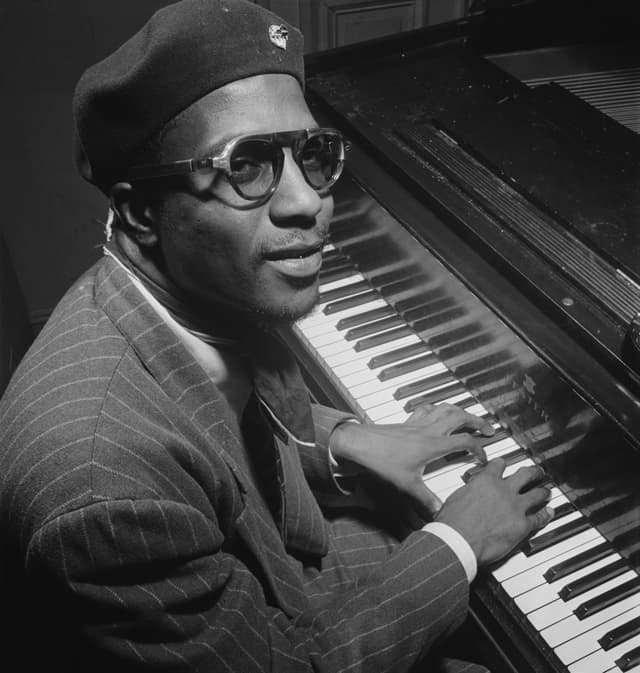
Monk's piano technique defied every principle taught in conservatories. He played with flat fingers rather than curved, attacked keys with percussive force that prioritized rhythm over legato smoothness, and constructed voicings that sounded like mistakes until you heard them twenty times and realized they were inevitabilities. His use of whole-tone scales, minor seconds, and tritone substitutions wasn't academic exercise—these intervals were emotional statements, expressing uncertainty, humor, melancholy, and defiance within single chords. When he played a "wrong" note, it reorganized everything around it, forcing reassessment of what correctness meant.
The stride piano tradition of James P. Johnson and Willie "The Lion" Smith provided Monk's rhythmic foundation, that left-hand locomotion that kept time while the right hand explored. But where stride masters emphasized fluidity, Monk fragmented the approach, inserting unexpected rests, displacing accents, creating polyrhythmic textures that made his solos feel like conversations between multiple personalities. His comping behind soloists was equally radical—sparse interjections that commented on what the horn player had just said, harmonic suggestions that opened new directions rather than reinforcing existing ones.
Listening to Monk requires adjusting your expectations about how jazz piano should sound. There's no Bill Evans lyricism, no Oscar Peterson velocity, no Ahmad Jamal restraint in the conventional sense. Instead, there's architectural thinking—each note placed with the care of someone constructing a building that needs to support weight from unconventional angles. His melodies moved in intervals that vocal jazz singers initially found unsingingable, yet became standards precisely because their angularity was memorable. The dissonance wasn't decoration; it was the point.
From Minton's to Mainstream Recognition: Monk's Long Road to Acceptance
Monk's professional career began in the early 1940s as house pianist at Minton's Playhouse in Harlem, the legendary after-hours club where bebop's vocabulary was being forged. While Dizzy Gillespie and Charlie Parker received credit for revolutionizing jazz harmony and rhythm, Monk was already working at angles to their approach, his compositions too structurally unusual even for bebop's adventurous spirits. His first recordings as a leader came in 1947 for Blue Note, yielding performances that documented a fully formed artistic vision the market wasn't ready to absorb. Critics complained his playing was primitive; they meant it sounded nothing like what they expected modern jazz piano to be.
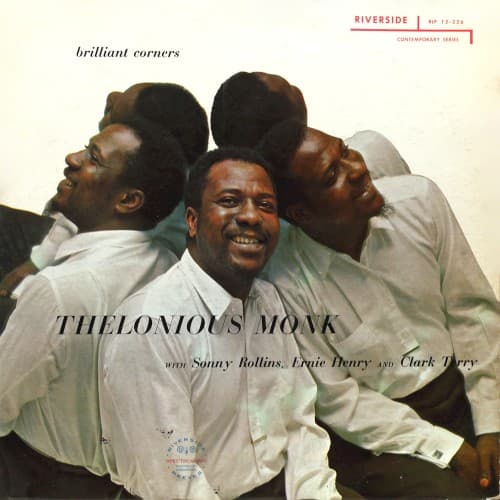
The 1950s brought professional catastrophe and slow artistic validation in equal measure. Monk lost his New York City cabaret card in 1951 following a drug arrest, effectively barring him from performing in the city's nightclubs for six years—precisely when bebop was consolidating its commercial foothold. He continued recording for Prestige and later Riverside, producing albums that would eventually be recognized as masterworks but initially sold poorly. His 1956 collaboration with Sonny Rollins, "Brilliant Corners," represented a turning point—the title track's metric complexity required multiple takes spliced together, yet the album's release coincided with growing recognition that Monk's difficulty was depth, not incompetence.
The late 1950s finally brought breakthrough momentum. A 1957 residency at the Five Spot with John Coltrane introduced Monk's music to a new generation of listeners and gave Coltrane an education in harmonic possibility that would reshape his own artistic trajectory. Monk's quartet recordings for Riverside between 1957 and 1961 captured him with sympathetic collaborators who understood his vision—tenor saxophonists like Johnny Griffin and Charlie Rouse, bassists like Wilbur Ware and Ahmed Abdul-Malik, drummers like Art Blakey and Roy Haynes. These recordings sold respectably, earned positive reviews, and established Monk as a major rather than marginal figure.
Signing with Columbia Records in 1962 represented commercial validation, the major label treating Monk as a prestige artist worthy of promotional investment. His early Columbia albums reached larger audiences, though some purists felt the label pushed him toward accessibility at the expense of experimentation. The truth was more complex: Monk's core aesthetic remained unchanged, but Columbia's distribution gave it broader reach. His 1963 cover of Time magazine—the second jazz musician ever featured after Duke Ellington—certified his transformation from cult figure to recognized genius. Extensive touring throughout the 1960s and early 1970s brought his music to international audiences, though the grueling schedule took physical and mental toll.
By the mid-1970s, Monk had largely withdrawn from public performance. His final concert occurred in 1976, and he spent his remaining years in seclusion at the New Jersey home of his longtime patron, Baroness Pannonica de Koenigswarter. The reasons for his withdrawal remain debated—mental health challenges, exhaustion, disillusionment, or simply an artist who'd said what he needed to say. He died in 1982, having witnessed his music's elevation from misunderstood experiment to essential canon.
Monk's Enduring Influence: How Dissonance Became Standard Language
Monk's compositional catalog remains unmatched in its combination of accessibility and complexity. "'Round Midnight" has been recorded thousands of times, yet each interpreter confronts its melodic architecture anew, discovering that what seems simple on paper reveals endless interpretive possibilities in execution. His compositions have become testing grounds for musicians proving they can navigate harmonic sophistication while maintaining emotional directness. The Monk aesthetic—angular melodies, unexpected harmonic movements, rhythmic displacement, space as compositional element—infiltrated jazz at every level, influencing not just pianists but arrangers, composers, and improvisers across all instruments.
His impact on piano specifically reshaped what the instrument could express in jazz context. Post-Monk pianists had permission to prioritize percussive attack, to leave gaps in their phrasing, to construct voicings that sounded wrong in isolation but perfect in context. Herbie Hancock absorbed Monk's use of space and dissonance, applying it to modal and fusion contexts. Andrew Hill built entire careers exploring the compositional possibilities Monk had opened. Even pianists who sound nothing like Monk—Keith Jarrett, McCoy Tyner, Chick Corea—operate in a landscape his work permanently altered.
Beyond technical influence, Monk represented artistic integrity as survival strategy. He never compromised his vision to appease critics, chase trends, or court commercial success, yet ultimately achieved recognition on his own terms. That model—the artist who trusts their vision enough to wait for the culture to catch up—resonates across creative disciplines. His physical presence on bandstands, rising from the piano to execute his shuffling dance while his band played, became iconic imagery representing jazz as embodied rather than merely intellectual practice. Monk's legacy isn't just the notes he played but the permission he granted future generations to sound like themselves rather than refined versions of their influences.