The scorecard
8.6/10 · Essential
- Composition20%
- 9.5
- Recording15%
- 7.0
- Performance30%
- 9.0
- Cohesion15%
- 8.0
- Originality10%
- 9.0
- Replay value10%
- 8.5
The title track's twenty-five-take difficulty is the proof: an eight-bar, seven-bar, modified seven-bar structure with double-time shifts that defeated a band with Rollins and Roach.
Keepnews assembled a complete take of the title track from multiple attempts because none of the twenty-five worked, and Pettiford's pantomiming incident suggests balance problems in the room.
Rollins and Roach navigate Monk's rhythmic traps with authority, and the rhythm section on the December session gives Bemsha Swing the space it needs.
Five tracks over thirty-three minutes with two different quintets and a solo piano piece: no filler, but the December sessions feel like repairs rather than a planned arc.
The title track's ternary form and rhythmic accents broke from standard song form and blues structures, and Ba-lue Bolivar Ba-lues-are runs thirteen minutes without repeating a phrase.
The compositions reveal new angles on each listen, though the edited title track and the lineup changes make it feel less like a single statement than a set of related arguments.
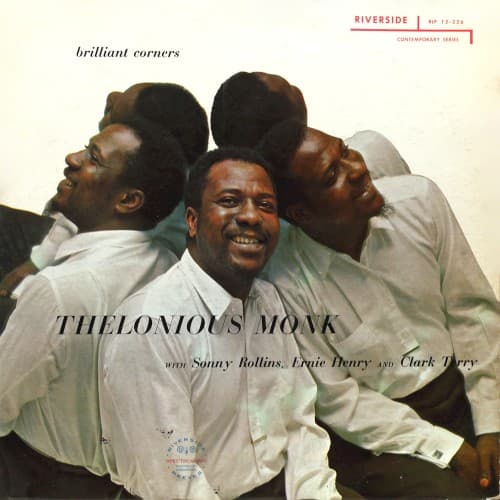
Thelonious Monk Brilliant Corners — The Album That Took Twenty-Five Takes
Brilliant Corners is the sound of a composer writing past what a band could play in one take. The title track required twenty-five attempts across a four-hour session in October 1956, defeated Ernie Henry and Oscar Pettiford badly enough that Pettiford pantomimed his part at one point, and ended up as an edit from multiple takes because no single version made it through. The difficulty was not the players. Sonny Rollins and Max Roach were as technically capable as anyone working in 1957, and Pettiford was among the most reliable bassists in modern jazz. The problem was the composition itself: an eight-bar A section, a seven-bar B section, a modified seven-bar A return, double-time theme statements in the second chorus, and rhythmic accents placed where standard song form did not prepare you to expect them. Monk had written a piece that worked on paper and in his head but required a band to think in his terms in real time, and when they could not, he made the album anyway.
Brilliant Corners is the first Riverside album built entirely around Monk's own writing, and it establishes the terms his work would demand for the next decade. The compositions here do not follow bebop's extensions of standard changes, and they do not smooth out blues forms. They build new structures that treat rhythm and meter as variables, not foundations, and they ask soloists to navigate them without a map. The stakes were clear to critics in 1957: DownBeat called it the most acclaimed jazz album of the year, and Nat Hentoff gave it five stars immediately. The album became a cornerstone of the hard bop era and earned induction into the Grammy Hall of Fame and the Library of Congress National Recording Registry. What makes it essential is not its difficulty as a historical fact but the fact that the difficulty is audible in every bar, and the music that survives the struggle is worth the cost.
Compositions That Punish Assumptions
Monk's writing on Brilliant Corners assumes nothing about what a jazz composition should do. The title track's ternary form and irregular phrase lengths force soloists to count bars and anticipate transitions that standard AABA or twelve-bar blues would have automated. The double-time theme statements in the second chorus are not ornamental; they change the rhythmic grid mid-solo and require the band to shift without a cue. Rollins handles it by playing around the structure rather than through it, leaving space where the form turns and landing his phrases after the downbeat rather than on it. Roach matches him by displacing accents across the bar line, so the rhythm section breathes with the composition instead of anchoring it. The editing that Orrin Keepnews had to do to assemble a complete take is audible if you listen for it, but the seams matter less than the fact that the piece demands this much precision in the first place.
Ba-lue Bolivar Ba-lues-are, titled after Monk's exaggerated pronunciation of Blue Bolivar Blues, runs thirteen minutes and twenty-four seconds without settling into a groove or repeating a phrase. The form is blues-adjacent but not a blues: Monk stretches and compresses the changes until the harmonic rhythm stops lining up with the meter, and the soloists have to follow his piano to know where they are. Henry and Rollins play off each other in the front line, but neither of them locks into a comfortable pocket because Monk will not give them one. The recording captures the room well enough that you can hear Pettiford and Roach working to hold the form together while Monk pushes against it. Pannonica, recorded the same day, is the gentlest piece on the album and the only one where Monk plays celesta instead of piano. The texture is softer, but the harmonic movement is just as oblique: the melody drifts through the changes without resolving in expected places, and Rollins plays it as a meditation rather than a statement.
The two tracks from the December session repair the October lineup after the title track sessions collapsed. Bemsha Swing, co-written with drummer Denzil Best and the only previously recorded composition here, is the most straightforward piece on the album, but Paul Chambers and Clark Terry bring a lighter feel than the October band. Roach plays timpani instead of full kit, and the low-end rumble gives the piece a ceremonial weight that Monk's piano cuts through with sharp, blocky chords. I Surrender Dear, the only standard and the only solo piano track, is Monk at his most skeletal: he strips the melody down to its intervals and rebuilds it with dissonances that make the song sound unfamiliar. The performance is under five and a half minutes, and it serves as a palate cleanser after the density of the full-band tracks, but it also proves that Monk's harmonic thinking works whether or not anyone else is in the room.
The weakness of Brilliant Corners is that it sounds like two sessions stitched together because that is what it is. The October band tackled the most demanding material and barely survived it, and the December session added two pieces that feel less central to the album's argument. Terry and Chambers are strong players, but Bemsha Swing does not require the same level of precision that the title track did, and the shift in energy is noticeable. The sequencing spreads the December tracks across the second side of the original LP, but the contrast between the October sessions' intensity and the December sessions' relative ease makes the album feel uneven. Keepnews did what he could to make it cohere, but the liner notes and the editing history are part of the record now, and they remind you that this is an album Monk had to force into existence.
The Album as a Test
Brilliant Corners does not build to a climax or ease you into its ideas. It opens with the most difficult piece Monk had written to that point, and it asks whether you can stay with it through seven minutes and forty-two seconds of irregular phrases and displaced accents. The first stretch delivers the thesis through harmonic ambiguity and rhythmic drift, then offers a moment of calm that still does not resolve into anything predictable. The pacing is front-loaded: the October sessions are the argument, and the December sessions are the addendum.
By the time you reach the back half, the album has already made its case, and the final two tracks feel like a cool-down rather than a continuation. The sequencing works because Monk is not trying to build an arc. He is presenting five compositions that function as arguments about what jazz form can be, and the order in which you hear them matters less than the fact that each one refuses to meet you halfway. The length is earned on the October tracks, where the density of the writing justifies the running time, and it sags slightly on the fifth piece, which stretches a simpler idea across seven minutes that could have been five.
The closing track earns its length by doing something entirely different: it takes a standard and makes it unrecognizable, and the brevity is a choice rather than a constraint. The album as a whole feels shorter than its thirty-three minutes because the compositions do not waste time, but it also feels longer because the listening demands concentration. You cannot put this on in the background and expect it to behave.
Where It Stands and Who It Is For
Brilliant Corners ranks among the essential Monk albums because it is the first one where his writing, not his playing or his sidemen, drives the session. The compositions here set the standard for the rest of his Riverside catalog and proved that Monk could build an album around his own material without compromise. It sits alongside the best hard bop records of the fifties not because it fits the style but because it defined one edge of what the style could accommodate. Rosenthal called it a classic hard bop session, and Christgau placed it at Monk's artistic peak alongside Misterioso, but its importance is less about peak achievement than about what it made possible.
After Brilliant Corners, other pianists and composers knew that irregular forms and rhythmic complexity could work in a studio album, and Monk himself knew he could demand this level of precision and get it, even if it took twenty-five takes and an edit. This album is for listeners who want to hear composition as an active challenge rather than a framework for blowing. If you expect hard bop to mean groove-based blues and standards with extended solos, Brilliant Corners will frustrate you. If you want to hear what happens when a composer writes forms that test a band's ability to stay together, this is the clearest example in Monk's catalog.
Start with the title track and Ba-lue Bolivar Ba-lues-are: if those two pieces sound like arguments worth following, the rest of the album will justify itself. If they sound like obstacles unnecessarily imposed, you will find more accessible entry points in Monk's later Riverside work or his Columbia recordings. For next steps, Monk's Music from later in 1957 takes the compositional density of Brilliant Corners and applies it to a larger ensemble, and Misterioso captures the same band energy in a live setting without the studio's edit-and-repair process. Brilliant Corners is not the easiest Monk album to love, but it is the one that proves his compositions could stand on their own terms, and the terms were not negotiable.
Track by track
Track Listing
Brilliant Corners
StandoutThe title track is Monk's most structurally ambitious composition to this point and the reason the album exists. The ternary form with eight-bar, seven-bar, and modified seven-bar sections creates a structure that does not repeat in predictable ways, and the double-time theme statements in the second chorus force the soloists to recalibrate mid-phrase. Rollins navigates it by treating the form as a puzzle rather than a grid: he leaves space before the transitions, lands his phrases after the downbeat, and plays with Monk's rhythmic displacements rather than against them. Roach matches him by scattering accents across the bar line and pushing the tempo without rushing it. Henry, by contrast, sounds less comfortable; the alto solo is competent but cautious, and the twenty-five-take sessions suggest he never fully internalized the form. Pettiford holds the bottom together, but the fact that he pantomimed during one take indicates the strain. The edit that Keepnews assembled from multiple takes is seamless enough that the average listener will not catch it, but the structure itself is so demanding that the difficulty is audible in every transition. The piece works because it refuses to make concessions, and the band rises to meet it even when they do not quite get there in one attempt. This is Monk writing at the edge of what a quintet could execute in 1956, and the result is one of the defining compositions of the hard bop era.
Ba-lue Bolivar Ba-lues-are
StandoutA thirteen-minute blues that is not quite a blues, titled after Monk's exaggerated pronunciation and named for the Bolivar Hotel where Pannonica de Koenigswarter lived. The form stretches and compresses the twelve-bar structure until the harmonic rhythm no longer aligns with the meter, and the soloists have to follow Monk's piano to stay oriented. Rollins and Henry trade phrases in the front line, but neither settles into a groove because Monk keeps shifting the foundation. The length is justified by the density of the writing: Monk never repeats a phrase or lets the form coast, and the rhythm section with Pettiford and Roach works harder here than on any other track to hold the structure together while Monk pulls against it. The piece is a test of endurance and concentration, and it rewards close listening with harmonic details that would disappear in a shorter performance. The recording captures the room well, and you can hear the musicians breathing and adjusting in real time. This is Monk at his most relentless, and the soloists prove they can stay with him even when the path is unclear.
Pannonica
StandoutThe gentlest piece on the album, named for the same patron as the previous track and featuring Monk on celesta instead of piano. The texture is softer and the melody drifts rather than stabs, but the harmonic movement is still oblique: the changes do not resolve where standard ballad form would place them, and Rollins plays the melody as a meditation rather than a statement. The celesta gives the piece a music-box quality that contrasts sharply with the percussive piano on the rest of the album, and Monk uses the instrument's limited dynamic range to force a quieter, more considered approach. Roach plays with brushes and keeps the rhythm light, and Pettiford walks without pushing. The piece is less structurally complex than the title track or Ba-lue Bolivar Ba-lues-are, but it still refuses to settle into predictable patterns, and the soloists have to listen closely to know where the form is going. At just under nine minutes, it is the right length for the material: long enough to develop the theme without overstaying its welcome.
I Surrender, Dear
StandoutThe only standard on the album and the only solo piano performance. Monk strips the melody down to its intervals and rebuilds it with dissonances that make the song unrecognizable if you do not know the changes. He treats the theme as raw material rather than a finished statement, and the performance is more about what he removes than what he adds. The harmonic substitutions are dense but not cluttered, and the rhythm is fractured without losing the underlying pulse. At five and a half minutes, it is the shortest full track on the album, and it serves as a palate cleanser after the density of the full-band sessions. The performance proves that Monk's harmonic thinking works whether or not anyone else is in the room, and it demonstrates that his approach to standards is as radical as his approach to his own compositions. This is Monk alone, making a familiar song sound like a new argument.
Bemsha Swing
SolidCo-written with drummer Denzil Best and the only previously recorded composition on the album, performed here with the December lineup of Terry, Chambers, and Roach. The piece is the most straightforward on the record, built on a repeating theme that does not require the same level of precision as the title track. Terry's trumpet brings a lighter, more playful feel than Henry's alto, and Chambers walks with more bounce than Pettiford. Roach plays timpani instead of full kit, and the low-end rumble gives the piece a ceremonial weight that contrasts with Monk's blocky piano chords. The performance is solid but not essential: it stretches a simple idea across seven minutes that could have been five, and it feels like a cooldown after the intensity of the October sessions. The piece works as part of the album's second side, but it does not carry the same weight as the compositions that preceded it. This is Monk writing for accessibility, and the result is competent without being revelatory.