Style & Context
Influences
Caribbean folk painting, Henri Rousseau, WPA murals, children's book illustration
Location
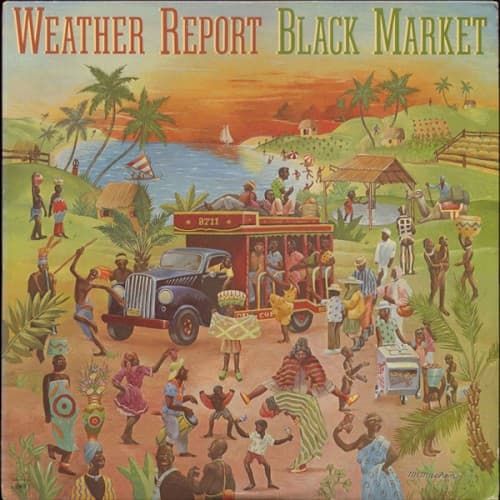
The scene depicts an idealized Caribbean or African coastal community, reflecting the album's Afro-Cuban and world music explorations.
Visual Language
The flattened perspective and simplified forms create accessibility while maintaining visual complexity through pattern and detail.
Symbols
Central market truck
The vehicle serves as the album's beating heart, a mobile gathering point where music and commerce intersect naturally.
Radiating sunset
The expanding sun mirrors how Weather Report's sound radiated outward, absorbing Caribbean and African rhythms into jazz fusion.
Waterfront and sailboat
Maritime imagery suggests the cultural currents and trade routes that carried musical traditions across the Atlantic and Caribbean.
Where Sound Meets Image
The cover's layered activity mirrors the album's dense polyrhythmic textures, where multiple percussion voices and Jaco Pastorius's melodic bass lines weave together like the market's intersecting human stories. The tropical setting directly references tracks that incorporated Caribbean and African rhythmic frameworks into electric jazz structures. The absence of Western urban imagery reflects the band's deliberate movement away from American jazz-rock toward global fusion, making the market itself a metaphor for musical exchange and cross-pollination.
This cover helped establish visual language for world fusion albums throughout the late 1970s and 1980s, proving that sophisticated music could embrace warmth and accessibility in its presentation. The illustration style influenced countless fusion and Latin jazz releases, creating a template where vibrant community scenes signaled rhythmic complexity and cultural authenticity. It remains one of Weather Report's most recognizable covers, frequently referenced in retrospectives and reissues as the visual embodiment of fusion's inclusive ambitions.