The Band That Rewrote Jazz's Electric Vocabulary
When Weather Report formed in 1971, jazz stood at a crossroads. Wayne Shorter and Joe Zawinul — both alumni of Miles Davis's electric experiments — chose not to follow the Davis blueprint but to demolish it entirely. They built something stranger and more ambitious: a collective improvisation model where keyboards, saxophones, and rhythm section functioned as equal voices in a constantly shifting sonic architecture. The band's name itself suggested their approach — atmospheric, unpredictable, fundamentally concerned with texture and environment rather than soloists trading fours over rhythm changes.
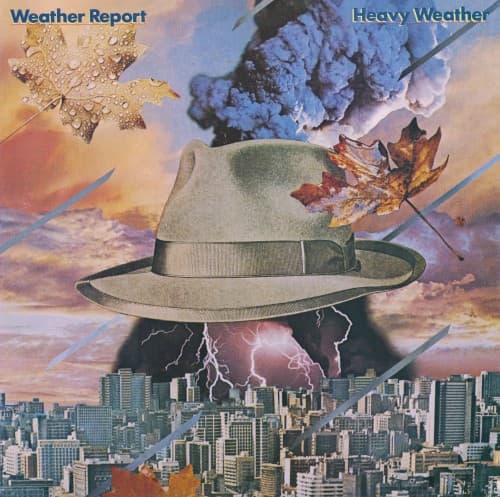
Across fifteen years and sixteen studio albums, Weather Report became the most commercially successful and artistically adventurous jazz fusion ensemble of the 1970s and early 1980s. They sold millions of records while maintaining genuine experimental credentials. Their 1977 masterwork Heavy Weather reached platinum status on the strength of "Birdland," a composition that somehow satisfied both jazz purists and FM radio programmers. Yet commercial triumph never dulled their exploratory edge — even at their peak, Weather Report remained committed to improvisation as a compositional tool and electronics as a means of expanding jazz's harmonic and timbral palette.
Their influence extends far beyond jazz. Weather Report's synthesis of African rhythms, electronic textures, and collective improvisation shaped fusion, smooth jazz, world music hybrids, and electronic production approaches across genres. Zawinul's keyboard orchestrations and Shorter's atmospheric saxophone work established templates still audible in contemporary jazz, while bassist Jaco Pastorius redefined what the electric bass could accomplish within an ensemble context.
Sonic Architecture: Layered Textures and Collective Improvisation
Weather Report never settled into a signature sound — their sonic identity was constant evolution. Early albums like "Weather Report" (1971) and "I Sing the Body Electric" (1972) emphasized collective free improvisation, with Shorter's soprano saxophone floating over Zawinul's electric piano textures and Miroslav Vitouš's melodic bass lines. These recordings feel exploratory, almost ambient at times, prioritizing atmosphere over conventional structure. Zawinul's use of the ARP 2600 synthesizer created swirling, orchestral backdrops that suggested weather patterns and natural phenomena rather than traditional jazz voicings.
The band's middle period brought rhythmic consolidation. "Black Market" (1976) introduced tighter grooves while maintaining improvisational space, but Heavy Weather crystallized their most accessible form — propulsive bass lines, layered keyboard textures, and Shorter's lyrical soprano work balanced perfectly between composition and spontaneity. Zawinul's Prophet-5 synthesizer gave the band a brighter, more melodic palette, while Pastorius's fretless bass provided both harmonic foundation and melodic counterpoint. His tone — singing, vocal, impossibly clean — became as recognizable as any horn player's voice.
Later albums like "Night Passage" (1980) and "Weather Report" (1982) explored denser polyrhythmic territories, incorporating Latin, African, and Middle Eastern percussion traditions. Zawinul's compositional control tightened, creating intricate through-composed pieces that left space for improvisation within predetermined structures. Shorter, meanwhile, developed an increasingly economical approach, using silence and space as actively as notes, his soprano lines often serving textural rather than soloistic functions. The production aesthetic remained remarkably consistent — clarity without sterility, electronic enhancement that felt organic rather than processed.
From Collective Vision to Zawinul's Orchestra: Weather Report's Fifteen-Year Evolution
Weather Report began as a genuinely democratic ensemble. Shorter and Zawinul shared leadership, Vitouš contributed compositions and conceptual direction, and drummers like Eric Gravatt and Dom Um Romão brought polyrhythmic complexity. The debut album's opening track "Milky Way" established their methodology — no clear melody, no soloist stepping forward, just five musicians generating continuous sound that evolved organically. Critics called it "ambient jazz" before ambient music had a name. Commercial reception was respectful but modest. This was music for committed listeners, not casual fans.
The first major shift came with "Mysterious Traveller" (1974), which introduced clearer melodic hooks and stronger rhythmic foundations without abandoning improvisational principles. Zawinul's title track became a fusion standard, its hypnotic groove and synthesizer melody demonstrating that accessibility and experimentation could coexist. Vitouš departed after this album, replaced by Alphonso Johnson, whose funk-influenced playing pushed the band toward denser, more propulsive rhythms. "Tale Spinnin'" (1975) and "Black Market" (1976) consolidated this direction, building larger audiences in both jazz and rock markets.
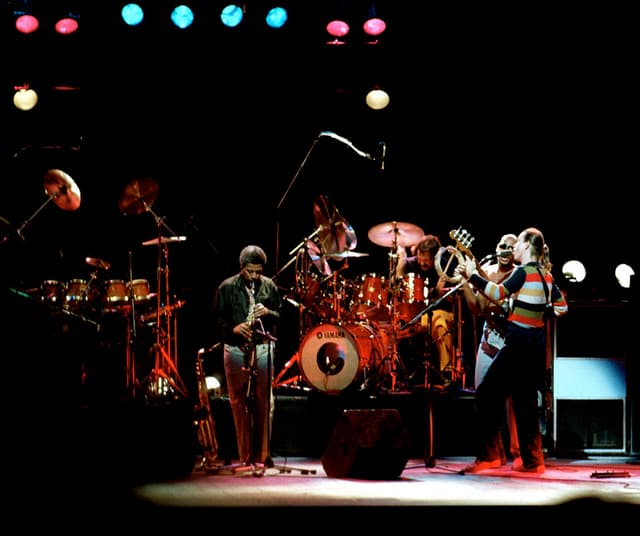
Pastorius's arrival for the Heavy Weather sessions transformed Weather Report into a commercial juggernaut. His fretless bass technique — harmonics, rapid-fire melodic runs, singing sustain — added a new melodic voice to the ensemble. "Birdland" became an unlikely hit, its infectious melody and Pastorius's anthemic bass line crossing over to pop radio. The album sold over a million copies and established Weather Report as fusion's flagship act. They toured extensively, playing rock venues and jazz festivals with equal authority, their live shows balancing composed material with extended improvisations that could stretch twenty minutes.
The early 1980s brought both creative peaks and internal tensions. "8:30" (1979), a double live album, captured the band's performance power — tighter, more muscular than their studio incarnation. "Night Passage" saw Pastorius contributing more compositions, his pieces like "Three Views of a Secret" expanding the band's harmonic vocabulary. But Pastorius's personal struggles led to his departure after "Weather Report" (1982), replaced by Victor Bailey. The final albums — "Procession" (1983), "Domino Theory" (1984), and "Sportin' Life" (1985) — maintained high musicianship but felt increasingly like Zawinul's solo projects with Shorter as featured guest.
They disbanded in 1986 without drama or definitive statement. Zawinul pursued solo work and eventually formed the Zawinul Syndicate, continuing to explore world music fusion and electronic textures. Shorter returned to acoustic jazz, leading quartets that emphasized open-ended improvisation and compositional abstraction. Both maintained that Weather Report had run its natural course — fifteen years, sixteen albums, a complete artistic statement. The band never reunited, preserving their legacy as a finite creative period rather than an ongoing nostalgia operation.
Weather Report's Enduring Impact on Jazz's Electric Frontier
Weather Report proved jazz fusion could be both artistically serious and commercially viable. While contemporaries like Return to Forever and Mahavishnu Orchestra emphasized virtuosic soloing and rock energy, Weather Report prioritized ensemble interplay and sonic texture. Their influence is clearest in bands that treat improvisation as collective creation rather than individual expression — groups like Snarky Puppy, The Bad Plus, and countless European jazz ensembles owe direct debts to Weather Report's methodology.
Zawinul's keyboard orchestrations changed how electronic instruments function in jazz. He treated synthesizers not as novelty sounds but as legitimate compositional tools capable of harmonic and textural complexity matching any acoustic instrument. Producers and arrangers across jazz, funk, and electronic music studied his layering techniques and timbral choices. Pastorius's bass work had even broader impact, fundamentally altering what bassists across all genres considered possible on the instrument. His harmonic approach, technical facility, and conceptual use of the bass as a melodic voice influenced everyone from Sting to Victor Wooten.
Shorter's work with Weather Report represents a fascinating counterpoint to his earlier hard bop and post-bop achievements. Where his Blue Note albums showcased compositional ingenuity and his Miles Davis tenure emphasized terse, blues-inflected statements, Weather Report allowed him to explore pure sound and atmosphere. His later acoustic quartets built directly on this foundation, applying Weather Report's improvisational ethics to acoustic instrumentation. The legacy is clear: jazz doesn't require conventional song forms or soloistic hierarchies to achieve emotional depth and intellectual substance. Weather Report made that argument for fifteen years, and the music still sounds like tomorrow.