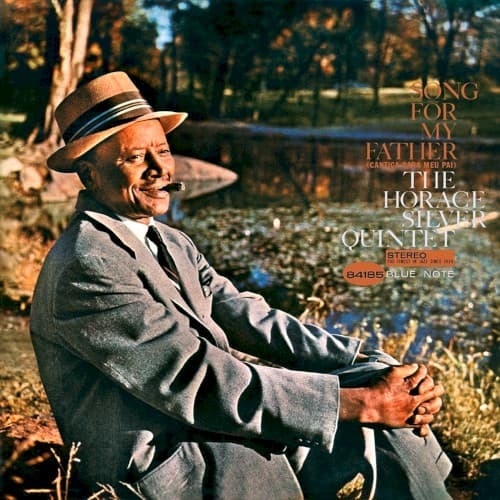
The scorecard
8.3/10 · Great
- Composition20%
- 9.0
- Recording15%
- 8.0
- Performance30%
- 8.5
- Cohesion15%
- 7.0
- Originality10%
- 8.0
- Replay value10%
- 9.0
"Song for My Father" and "Que Pasa" build entire performances on hooks simple enough to whistle and sturdy enough to sustain long improvisations.
Rudy Van Gelder's engineering gives every instrument its own depth plane: the piano cuts without glare, the horns bloom without bleed, and the bass sits exactly where the rhythm needs it.
Joe Henderson's solo on "The Natives Are Restless Tonight" and Carmell Jones's trumpet on "Song for My Father" show both precision and invention, riding Silver's grooves without getting stuck in them.
The personnel change between sessions scatters the ensemble sound, and "Lonely Woman" at the end feels like an appendix rather than a conclusion.
The bossa nova and Latin inflections were part of the hard bop conversation by 1964, but Silver makes the rhythms his own by keeping the attack percussive and the voicings funky.
The title track alone has justified sixty years of reissues; the album as a whole rewards the hundredth listen as much as the first.
Horace Silver Song for My Father — How a Groove Outlasted a Quintet
The argument for Song for My Father rests on twelve measures: a bass line borrowed from Brazilian samba but played with a shuffle, a two-chord vamp that leaves all the room a soloist needs, and a melody you remember before the track is over. The composition "Song for My Father" became Horace Silver's signature not because it was complicated but because it worked, and it worked because Silver understood that a groove strong enough to carry a seven-minute performance had to be simple enough to sit in the pocket without effort. The rest of the album tries to live up to that standard, and most of it succeeds.
The complication is that the record captures a quintet in transition. Silver's working band with Blue Mitchell on trumpet and Junior Cook on tenor appears on only one track from the original LP, "Calcutta Cutie," recorded a year before the title track. The newer lineup with Carmell Jones and Joe Henderson plays the other four pieces, recorded in October 1964. The shift in personnel splits the album's sound: the older session has the lived-in feel of a working group, the newer ones have the edge of players still figuring each other out. That the album coheres at all is a credit to Silver's writing, which gives both lineups frameworks built to last. That it became a hard bop landmark anyway says something about the strength of three or four compositions and the way Van Gelder's engineering makes every session sound like it belongs on the same record, regardless of who is playing.
Grooves Built to Carry Weight
Silver's writing here is functional in the best sense: themes designed to set up solos, with enough melodic content to return to and enough space in the changes to let the rhythm section breathe. "Song for My Father" is the template. The bass line, recorded with Gene Taylor's upright mixed forward, drives the track without ever pushing. The piano montuno sits just behind the beat, and the two-chord harmony holds the form open for Henderson's tenor and Jones's trumpet to stretch out without losing the thread. The tune does not develop or modulate; it simply repeats, and the repetition becomes hypnotic rather than static because the soloists keep finding new lines over the same changes. Silver's own solo is all attack and release, the right hand percussive and the left hand doubling the bass, rhythm and melody inseparable.
The other Latin-inflected pieces work variations on the same principle. "The Natives Are Restless Tonight" tightens the rhythm to a mambo, the drums and bass locked in a pattern that does not waver, and the horns trade phrases over the top without ever stepping on the groove. "Que Pasa" splits the difference, a slower bossa with more space in the arrangement and a melody that lets the soloists play around the form rather than just over it. All three tracks rely on the same engineering choices: Van Gelder records the rhythm section dry and close, the piano bright without being brittle, the bass full without getting muddy, and the drums crisp enough that every rimshot and hi-hat hit registers without cluttering the mix. The horns get just enough room tone to sit in the ensemble without floating above it. Nothing sounds distant and nothing crowds.
The hard bop pieces without Latin rhythm show the range Silver's writing had by 1964, but also where the quintet transition costs the album. "Calcutta Cutie," the longest track, opens with a brooding minor theme and Blue Mitchell's trumpet in conversation with Junior Cook's tenor, the two horns finishing each other's phrases in a way that only comes from months on the bandstand together. The solos stretch longer here than anywhere else on the record, and the interplay between trumpet and tenor in the head feels lived-in. By contrast, Jones and Henderson on "The Kicker" play with precision but not the same intuition: the arrangement is tighter, the solos shorter, and the feel more sectional. Henderson wrote "The Kicker" himself, and it shows in the way the tenor solo dominates the track. The rhythm section is excellent on both sessions, but the older lineup sounds like a band, the newer one like five good players.
"Lonely Woman," the ballad closer, is a piano trio feature with Gene Taylor and Roy Brooks. It does not belong sequentially to either quintet session, and it does not quite belong at the end of this album: the tempo drops too far, the harmonic motion slows, and the track trails off rather than resolving. It is well-played but it feels like an alternate take that made the LP to reach album length.
How to Sequence Around One Classic
The sequencing choice was obvious and correct: open with the title track, the one piece on the album that everyone would know and most would buy the record for. The opening number at seven minutes sets the standard, and the rest of the album either meets it or does not. The second track follows without a gap in energy, the mambo rhythm a natural extension of the samba feel, and the two pieces together give the album fifteen minutes of sustained momentum before the pace changes.
The middle of the record is where the personnel shift becomes audible. The third track is the longest and the one that sounds the most like a working quintet stretching out in the studio, but it also slows the album's forward drive. By the time the fourth piece arrives, the flow has stalled, and the track has to rebuild the energy rather than sustaining it. The fifth number is sharp and efficient, but at five and a half minutes it is over before it fully develops. The closer brings the album to a near halt: the ballad tempo and trio format make it feel like an epilogue rather than a conclusion, and the record fades rather than ending with intent.
The album's length is exactly right for the number of strong pieces it contains. The weak link is the order: front-loading the two best Latin grooves leaves the second half to coast on the strength of the playing without the same compositional hooks. A better sequence might have split the grooves across the LP, but the decision to lead with the hit was a commercial necessity that the rest of the album could not quite overcome.
The Standard and Everything Else
Song for My Father is a one-track masterwork propped up by three or four other very good pieces and two that do not earn their space. The title composition is as essential as hard bop gets: a groove so sturdy and a melody so direct that it has outlasted every lineup that played it, every reissue that packaged it, and every covers version that borrowed it. If the rest of the album matched that standard, this would be an untouchable classic. It does not, but what surrounds the centerpiece is still well above the genre's median.
The record ranks among Silver's best, though without catalog context yet that is a projection. It is the album to start with if you are coming to Silver for the first time, both because "Song for My Father" is required listening and because the Latin-inflected hard bop here shows what made his writing influential. If you are already familiar with his work, the question is whether the three or four keepers justify the weaker moments. They do, but barely. "Calcutta Cutie" and "The Kicker" are strong enough to return to; "Lonely Woman" is not.
Skip this if you are looking for a hard bop album that flows front to back without weak spots. The personnel transition and the ballad closer break the continuity, and the sequencing does not help. For everyone else, play "Song for My Father" first, then "The Natives Are Restless Tonight," then decide whether the rest is worth your time. If you want more Silver after this, the logical next step is to work backward through his Blue Note catalog to hear the earlier quintets in full working form. If you want more Latin-inflected jazz piano from the same era, Herbie Hancock's Empyrean Isles covers similar ground with tighter personnel and better sequencing.
Track by track
Track Listing
Song for My Father
StandoutThe bass line is the composition. Gene Taylor's upright walks a samba-derived pattern that never wavers, two chords that repeat for seven minutes, and everything else in the arrangement exists to support or embellish that foundation. Silver's piano montuno sits behind the beat, percussive chords with the sustain pedal up, and the melody appears in two-bar phrases that leave room for the rhythm to breathe. Joe Henderson's tenor solo is all long lines and rhythmic displacement, playing around the downbeat without losing the groove, and his tone is dry enough to cut through the piano without fighting it. Carmell Jones follows with a trumpet solo that stays closer to the melody, shorter phrases and more space, letting the bass line do the work. Silver's solo is the most percussive of the three, the right hand stabbing chords and the left hand doubling the bass, and the attack is so consistent that the piano becomes part of the rhythm section rather than floating above it. Roger Humphries on drums plays the samba pattern straight, no fills or flourishes, and the restraint is what makes the groove lock. The arrangement never modulates, never shifts tempo, never breaks the pattern, and the repetition is hypnotic rather than monotonous because the soloists keep finding new ways to phrase over the same changes. This is the track that justified the album and the reason it stayed in print for sixty years.
The Natives Are Restless Tonight
StandoutThe rhythm shifts from samba to mambo, tighter and more percussive, and the melody is a two-horn riff that sounds like it was written in the studio. The arrangement is call-and-response: trumpet and tenor trade phrases over a one-chord vamp, and the rhythm section stays locked in the mambo pattern without variation. Henderson's solo is the centerpiece, longer and more developed than his spot on the title track, and the lines are jagged and unpredictable, cutting across the beat and then snapping back into the groove. Jones's trumpet solo is shorter and more lyrical, smoother phrases that ride the rhythm rather than fighting it. Silver's solo is functional, keeping the groove going without adding much melodic content. The energy never drops, and the track works as a natural extension of "Song for My Father" without repeating it. The sequencing choice to place these two back-to-back gives the album its strongest opening.
Calcutta Cutie
SolidThe longest track on the original LP, and the only one featuring the older quintet with Blue Mitchell and Junior Cook. The theme is a brooding minor-key melody, slower and more harmonically complex than the Latin pieces, and the arrangement gives the horns room to develop ideas rather than just state them. Mitchell's trumpet and Cook's tenor play the head in close harmony, finishing each other's phrases, and the interplay shows the months they spent working together on the bandstand. The solos stretch longer here than anywhere else on the record: Cook's tenor solo builds slowly, starting with the melody and gradually moving away from it, and Mitchell's trumpet follows with a solo that mirrors Cook's phrasing without copying it. Silver's solo is more harmonically adventurous than his playing on the title track, moving through the changes rather than sitting on a vamp. Gene Taylor and Roy Brooks in the rhythm section are steady but less prominent in the mix than Teddy Smith and Humphries on the newer sessions. The track is well-played and the interplay between Mitchell and Cook is the best horn work on the album, but at eight and a half minutes it stalls the momentum built by the first two pieces. The sequencing would have been better served by splitting the Latin grooves across the LP rather than clustering them at the start.
Que pasa
SolidA slower bossa nova, less percussive than "Song for My Father" but built on the same principle: a two-chord vamp, a simple melody, and a rhythm section that locks in and does not move. The arrangement is sparser, more space between the phrases, and the melody is less immediate than the title track. Henderson's tenor solo is restrained, longer phrases and less rhythmic displacement, and the tone is warmer here than on the faster pieces. Jones's trumpet solo is similarly lyrical, playing around the melody rather than abandoning it. Silver's solo is the most harmonically interesting moment on the track, moving through chord substitutions that the rhythm section follows without breaking the bossa pattern. The groove works, but the melody is not strong enough to carry the seven-minute running time, and the track feels like a variation on "Song for My Father" rather than a composition with its own identity. It is solid but not essential.
The Kicker
SolidThe only composition not written by Silver; Joe Henderson contributed this one, and the arrangement reflects it. The melody is a fast, angular line built for the tenor, and the rhythm is straight-ahead hard bop, no Latin inflection. Henderson's solo dominates the track, and the lines are sharp and unpredictable, the kind of playing that shows off technical command. Jones's trumpet solo is shorter and more functional, keeping the energy up without adding much melodic content. Silver's solo is brief, a few choruses that keep the form moving. The rhythm section with Teddy Smith and Roger Humphries is tight, but the track is over in five and a half minutes, shorter than anything else on the original LP, and it feels like it ends before it fully develops. The arrangement is efficient, but the piece does not have the melodic hook or the groove to match the album's strongest tracks.
Lonely Woman
WeakA ballad trio feature with Silver, Gene Taylor on bass, and Roy Brooks on drums. The tempo is slow, the harmonic motion is minimal, and the track is all mood and no momentum. Silver's playing is lyrical and restrained, the kind of ballad work that shows touch rather than attack, but the piece does not build or develop, and the seven-minute running time is not earned. The melody is pleasant but forgettable, and the arrangement does not give Taylor or Brooks much to do beyond keeping time. The track feels like an alternate take that made the LP to reach album length, and the sequencing choice to place it at the end brings the album to a halt rather than a conclusion. It is well-played but it does not belong here.