The scorecard
9.0/10 · Essential
- Composition20%
- 9.5
- Recording15%
- 8.0
- Performance30%
- 9.5
- Cohesion15%
- 8.5
- Originality10%
- 9.0
- Replay value10%
- 9.0
St. Thomas and Blue 7 build extended solo frameworks from minimal material, each theme engineered to reward long development without collapsing into repetition.
Van Gelder's Hackensack mono gives Rollins forward presence while keeping Flanagan's comping and Roach's brushwork audible, though Watkins sits farther back than ideal.
Rollins plays with complete command across tempos and moods, from the calypso lilt of St. Thomas to the extended thematic invention on Blue 7, while Roach matches every shift.
Five tracks, no filler, each serving a different function: the calypso opener, the ballad, the burner, the theatrical set piece, the long-form statement.
Blue 7 introduces thematic improvisation as a structural principle rather than a parlor trick, a method that shaped how saxophonists thought about solo construction for the next decade.
The album remains instructive on repeated listens because Rollins telegraphs his logic: you hear him build, vary and resolve each idea in real time.
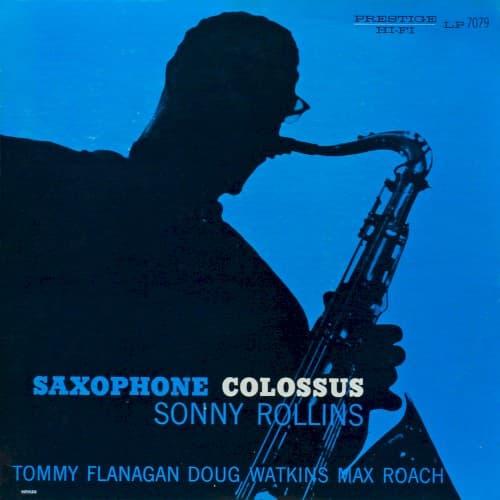
Sonny Rollins Saxophone Colossus — The Album That Proved a Solo Could Think
Saxophone Colossus answers a question that was hanging over hard bop in 1956: whether a saxophonist could build a solo with the same kind of internal logic that a composer brings to a written piece, making each chorus feel like the necessary next step rather than a string of hot licks. Rollins had been moving toward an answer for years, using motifs and rhythmic cells as building blocks instead of running changes, but this album is where the method announces itself plainly enough that other players could study it. Blue 7, the eleven-minute closer, is the clearest demonstration: Rollins takes a three-note blues figure and spends the entire track varying, inverting and recontextualizing it, so that the solo feels composed even though it is not written down. The album became a handbook because it made thematic improvisation audible as a process, not a mystery.
The stakes were professional as much as artistic. By mid-1956 Rollins was a respected sideman in the Clifford Brown/Max Roach Quintet, but not yet a front-rank leader. Saxophone Colossus, recorded on June 22 at Rudy Van Gelder's Hackensack studio with producer Bob Weinstock, changed that. The quartet on the date included Roach, pianist Tommy Flanagan and bassist Doug Watkins, and the session took place four days before Brown and pianist Richie Powell died in a car accident on the way to a Chicago gig.
Rollins was not in the car, and the album came out the following spring to reviews that positioned him as a major voice rather than a rising one. Ralph J. Gleason wrote in DownBeat that Rollins displayed humor, gentleness and beauty alongside the hard swing, a range that the album demonstrates across five tracks with no weak cuts. In 2016 the Library of Congress added it to the National Recording Registry. The claim the album makes is that a solo can be as tightly argued as a composition if the soloist thinks architecturally, and the solos here prove it.
How Rollins Built Solos Like a Composer Writing in Real Time
The core method is motif and variation: Rollins states a simple melodic or rhythmic idea, then subjects it to inversions, rhythmic displacements, octave jumps and harmonic recontextualization, so that each chorus grows from the last rather than starting over. On Blue 7 the process is unusually transparent because the theme itself is just a three-note blues riff, leaving Rollins nowhere to hide. He spends eleven minutes demonstrating how much can be extracted from almost nothing, varying the rhythm, flipping the intervals, quoting the figure in different registers and reharmonizing it against Flanagan's chords. The solo is a lesson in development, and it sounds like one: you can hear Rollins thinking through the possibilities in sequence, making each variation feel like the logical next move. The piece became a touchstone for saxophonists trying to build longer solos that did not rely on running eighth-note lines over changes.
On St. Thomas the method adapts to a different task. The calypso theme, which Rollins wrote based on a tune he remembered from his mother's Virgin Islands background, is catchy and symmetrical, and the challenge is to improvise on it without losing the island lilt or turning it into a blowing vehicle. Rollins meets that by keeping the rhythmic feel of the theme alive in his phrasing: even when he is playing fast lines he accents the calypso pulse, so the solo sounds like an extension of the melody rather than a departure from it. Roach, playing with brushes for most of the track, shadows Rollins's rhythmic choices and leaves space around the phrases. The interplay is conversational, with Roach responding to Rollins's accents rather than laying down a static groove.
Flanagan and Watkins function as support rather than co-soloists. Flanagan comps cleanly behind Rollins and takes short, chord-based solos that stay out of the way; Watkins walks steady lines and never intrudes. The rhythm section's job is to give Rollins a stable platform and to stay alert to his rhythmic games, and they do both. Roach is the most active partner, adjusting his attacks and densities to match Rollins's dynamics, particularly on the faster tracks where Rollins varies his volume and articulation within a single phrase. The production, recorded in mono by Van Gelder, gives Rollins a forward presence without burying the rhythm section, though Watkins's bass is mixed lower than it should be and occasionally disappears under Flanagan's left hand.
The weakness is that the thematic method, for all its logic, can feel studied when Rollins applies it mechanically. On Strode Rode, a fast original, he uses the same motif-and-variation approach but without the melodic interest of St. Thomas or the structural clarity of Blue 7, and the result is a competent hard-bop track that does not justify its place among the more inventive cuts. The solo is well-constructed but predictable, and the track feels like an exercise compared to the innovations around it.
An Album Sequenced to Demonstrate Range Without Wasting Time
The five tracks are arranged to show different aspects of Rollins's playing: the calypso swing of the opener, the ballad sensitivity at track two, the hard-bop energy in the middle, the theatrical wit returning on side two, and the long-form thematic architecture of the closer. The sequencing is purposeful, moving from accessible to ambitious, and the variety keeps the album from feeling like a single-minded manifesto. The only standard and the only ballad sits second and functions as a breather, giving Rollins space to play quietly and use silence as a structural tool. The opening of the second side features a tongue-in-cheek ten-minute performance that treats the Weill melody as a springboard for games with tempo and timbre, Rollins bending notes and growling through the horn in ways that undercut the tune's Brechtian menace with humor.
The album earns its length by giving each track a distinct function. The first and last tracks are the conceptual anchors, the former proving that thematic improvisation works on a singable tune and the latter proving it works on a minimal blues. The ballad shows that Rollins can play without resorting to cliches, and the side-two opener shows that he can entertain. The middle stretch is the only cut that feels obligatory, included to demonstrate up-tempo chops rather than to add something the other tracks do not cover.
The pacing sags slightly in the middle of the second side, where ten minutes of ironic cabaret begin to feel long, but the closer redeems the length by delivering the most ambitious performance on the record. The album does not overstay its welcome, and the two long tracks justify their runtime by doing things the shorter ones cannot.
The Album That Made Rollins a Leader and Gave Saxophonists a Blueprint
Saxophone Colossus ranks as Rollins's most influential album because it codified thematic improvisation as a teachable method, turning an instinct into a tool that other players could study and apply. It is not his most adventurous record—later albums like Freedom Suite push harder against the hard-bop template—but it is the clearest demonstration of his core approach, and that clarity is why it became required listening for saxophonists trying to build solos that develop ideas rather than quote licks. The album works for listeners who want to understand how jazz improvisation functions as composition in real time, and it works for listeners who just want to hear a great tenor player at the peak of his powers with a rhythm section that knows when to push and when to lay back.
The album is not for listeners who want the kind of emotional catharsis that Coltrane brought to ballads or the sheer velocity that later Rollins brought to Freedom Suite. This is Rollins as architect, thinking through problems with clarity and wit, and the emphasis is on structure over feeling. The best entry point is St. Thomas, which delivers the thematic method in a package catchy enough to work as a standalone track, or You Don't Know What Love Is, which shows Rollins playing a ballad with restraint and intelligence. Blue 7 is the essential track for anyone studying solo construction, but it requires patience and attention to detail. Strode Rode can be skipped without losing the thread.
For the next album, try Freedom Suite, which takes the thematic method into longer forms and more politically charged territory, or Way Out West, which applies the same logic to a more playful set of tunes. Saxophone Colossus has aged well because the questions it answers—how to build a solo, how to develop a motif, how to improvise with logic—are still relevant. It remains the album that proved a solo could think, and the solos here still repay close listening because Rollins makes his thinking audible.
Track by track
Track Listing
St. Thomas
StandoutThe opening track introduces the album's thesis with a calypso melody that Rollins wrote based on a tune from his mother's Virgin Islands background. The theme is simple and symmetrical, built on a two-chord vamp that leaves plenty of room for improvisation, and Rollins uses it to demonstrate how thematic development works on a singable tune. His solo stays close to the rhythmic feel of the melody, accenting the calypso lilt even when he is playing faster lines, so that the improvisation sounds like an extension of the theme rather than a departure into generic hard-bop language. Roach plays mostly with brushes, shadowing Rollins's rhythmic choices and leaving space around the phrases, and the interplay between saxophone and drums is conversational rather than competitive. Flanagan comps cleanly and takes a short, chordal solo that does not distract from the main event. The track became a jazz standard, and it works here as both an introduction to Rollins's method and a standalone performance that rewards casual listening. It is the most accessible cut on the album and the best entry point for listeners new to Rollins's thematic approach.
You Don't Know What Love Is
StandoutThe only standard on the album and the only ballad, this track shows Rollins playing with restraint and using silence as a structural tool. He does not rush the melody or ornament it with cliches, instead stating the theme plainly and then building a solo that develops the tune's intervals and harmonies without wandering away from its melancholy mood. The performance is quiet and thoughtful, with Flanagan providing sparse accompaniment and Roach playing with brushes at low volume. Rollins's tone is softer here than on the up-tempo tracks, and he uses space between phrases to let ideas settle before moving to the next variation. The track functions as a breather between the calypso energy of St. Thomas and the hard-bop drive of Strode Rode, and it demonstrates that Rollins can play a ballad without resorting to sentimentality or technical showboating.
Strode Rode
SolidA fast original that applies the motif-and-variation method to a hard-bop blowing vehicle, this track is the weakest on the album because it does not add anything that the other cuts do not cover more effectively. Rollins plays a well-constructed solo that uses rhythmic displacement and octave jumps to develop the theme, but the theme itself is not as memorable as St. Thomas or as minimal as Blue 7, and the solo feels like an exercise in technique rather than a demonstration of new ideas. Roach drives the tempo with crisp ride cymbal work, and Flanagan takes a short, bluesy solo, but the track does not justify its five-minute runtime. It sits in the middle of the first side and disrupts the flow between the more inventive performances, included to show that Rollins can play fast changes but not to advance the album's argument. Competent filler.
Moritat
SolidA ten-minute performance of Mack the Knife that treats the Weill melody as a springboard for games with tempo, timbre and irony. Rollins opens with the theme stated plainly, then spends the rest of the track bending notes, growling through the horn, and playing with rhythmic displacement in ways that undercut the tune's Brechtian menace with humor. The solo is theatrical and playful, more interested in entertaining than in demonstrating thematic logic, and it works as a contrast to the more serious architecture of Blue 7. Roach and Flanagan follow Rollins's tempo shifts and dynamic changes without losing the groove, and the rhythm section's responsiveness keeps the performance from feeling like a solo showcase. The track runs long—Rollins exhausts the joke before the ten minutes are up—but it demonstrates a side of his playing that the other tracks do not emphasize, and it shows that he can work with a well-known melody without being constrained by reverence. The length is a problem, and the track sags in the middle, but the opening and closing choruses are sharp enough to justify its inclusion.
Blue 7
StandoutThe eleven-minute closer is the album's most ambitious performance and the clearest demonstration of thematic improvisation as a structural principle. The theme is a minimal three-note blues riff, so simple that it leaves Rollins with almost nothing to work with except the method itself. He spends the entire track varying the figure: inverting the intervals, displacing the rhythm, quoting it in different registers, reharmonizing it against Flanagan's chords, and using it as a launching point for longer phrases that return to the original motif for resolution. The solo is transparent in its logic—you can hear Rollins thinking through the possibilities in sequence, making each variation feel like the necessary next step—and that transparency is what made the track a handbook for saxophonists trying to build long solos that develop ideas rather than stringing together licks. Roach plays a drum solo in the middle that uses the same approach, taking a simple rhythmic figure and subjecting it to variations in dynamics and timbre, and the parallel structure reinforces the album's thesis that improvisation can function as composition if the soloist thinks architecturally. The track requires patience and attention to detail, and it is not the most emotionally engaging performance on the record, but it is the most important because it proves that the method works even when applied to the barest material. Essential listening for anyone studying solo construction, and the reason the album remains relevant nearly seventy years after it was recorded.