The scorecard
8.3/10 · Great
- Composition20%
- 8.5
- Recording15%
- 9.0
- Performance30%
- 8.0
- Cohesion15%
- 7.5
- Originality10%
- 9.0
- Replay value10%
- 8.5
Four compositions that give improvisers rhythmic frameworks worth exploring: the "Chameleon" bassline alone has sustained hundreds of covers and samples.
Fred Catero's engineering at Wally Heider captures the Clavinet's bite and the synthesizers' depth without losing the percussion or the space between players.
Mason and Jackson lock into grooves that never stiffen, and Maupin's soprano on "Watermelon Man" floats over the rhythm section without fighting it.
Two side-long tracks per LP side makes pacing easy, though "Vein Melter" feels like a cooldown rather than an earned conclusion.
Hancock abandoned the Mwandishi sextet's spacier experiments for funk rhythm sections and synthesizer basslines a year before fusion became a genre cliché.
The grooves stay funky after fifty years and the synthesizer timbres have aged better than most fusion keyboard sounds from the decade.
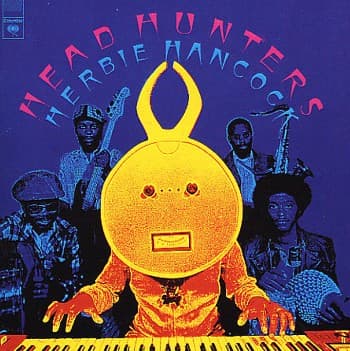
Herbie Hancock Head Hunters — The Album That Chose the Groove Over the Cosmos
Hancock had spent three albums chasing the outer edges of fusion with the Mwandishi sextet, stacking synthesizers and electric pianos into dense, searching textures that asked more questions than they answered. Then he got tired of heavy and cut a funk record. The thesis of Head Hunters is stated in the first minute of the opening track: a synthesizer bassline so direct and physical that it became one of the most sampled phrases in hip-hop history. Hancock was done with the upper atmosphere; he wanted a connection to the earth, and he found it by building grooves around the Hohner Clavinet and the ARP Odyssey instead of around guitar or acoustic piano.
The gamble was that a pianist known for harmonic sophistication and modal exploration could make a funk album without watering down either the funk or the jazz. Hancock won. Head Hunters became the best-selling jazz album to that point, hit number thirteen on the Billboard 200, and crossed over to rock and R&B audiences without chasing either crowd. It worked because the rhythm section of Paul Jackson and Harvey Mason played funk that could hold its own on Black radio, and because Hancock and Bennie Maupin treated the grooves as frameworks for improvisation rather than as background for solos. The album that resulted is tighter and more accessible than the Mwandishi records, but it is not simpler: the harmonic movement in the long tracks rewards attention, and the production captures details that a casual listen will miss. Fifty years later it remains the clearest answer to the question of whether jazz and funk could coexist without one colonizing the other.
Synthesizers as Rhythm Section, Rhythm Section as Lead
Hancock made two decisions that define the album's sound: he played all the synthesizer parts himself after sharing those duties with Patrick Gleeson on the previous two records, and he replaced guitar with the Hohner Clavinet. The Clavinet's percussive, funky tone became the album's signature texture, cutting through the mix on the verses and locking in with Jackson's bass guitar to create a low-end pocket that never gets muddy. The ARP Odyssey and ARP Pro Soloist handle basslines and lead lines that would normally go to a bassist or a horn, which frees Jackson to play counterpoint and frees Maupin to float over the groove instead of stating themes. The result is a band where the keyboards anchor the rhythm and the rhythm section improvises.
The production, handled by Hancock and David Rubinson with engineering by Fred Catero and a small team at Wally Heider Studios and Different Fur Trading Co., captures the synthesizers with unusual warmth and presence. The ARP Odyssey bassline on the opening track has weight and definition; the Rhodes on the closing track has enough room around it that Maupin's bass clarinet can breathe. Bill Summers plays a dozen percussion instruments across the album, most of them African, and the balafon and shekere are placed carefully enough in the stereo field that they add color without cluttering the groove. The quadraphonic mix released in 1974 includes elements absent from the stereo version, including an additional keyboard melody at the start of the third track, which suggests that the sessions were dense and that the final mixes were deliberate about what to foreground.
Maupin, the only holdover from the Mwandishi sextet, plays tenor and soprano saxophone, saxello, bass clarinet and alto flute, and he adjusts his phrasing to fit the new context. On the Mwandishi records he played long, searching lines over shifting rhythms; here he plays shorter, funkier phrases that hook into the groove and then break away from it. Mason, who would be replaced by Mike Clark on subsequent Headhunters albums, plays drums that swing without ever swinging in a bebop sense: the pocket is wide, the fills are minimal, and the bass drum pattern on the first track became a template for funk and hip-hop drummers. Jackson plays bass guitar with a round, melodic tone that recalls Larry Graham more than Ron Carter, and he and Hancock share bass duties across the album depending on who has the more interesting line.
The weakness is length without development. The first track runs over fifteen minutes and the third track runs over ten, but neither composition earns that duration through harmonic or thematic evolution: they are vamps with solos, and the pleasure is in the groove and the interplay rather than in any journey the tracks take. Listeners who need formal architecture will find the album repetitive. The album also has no guitar, which was a deliberate choice but which removes a timbral option that might have added contrast. The result is an album that works as a set of grooves with strong solos rather than as a set of compositions with strong structures.
Four Tracks, Two Long and Two Longer
The album is four tracks across two LP sides, with the long tracks front-loaded and the longest track opening. The sequencing puts the thesis first: the album starts with its most famous bassline and its most direct groove, which hooks the listener before the subtler tracks arrive. The second track, a reworking of a hard bop hit from Hancock's 1962 debut, adds African percussion and a beer bottle imitating a Pygmy flute, and it plays as a bridge between the old catalog and the new direction. The third track, dedicated to Sly Stone, pushes the tempo and the Clavinet higher in the mix, and it contains the most aggressive horn work on the record. The closing track downshifts into a slow Rhodes-and-bass-clarinet meditation that feels like a comedown after three uptempo grooves.
The pacing is a strength until the final track, which plays more like an afterthought than a resolution. The album earns its length on the first two tracks because the grooves are strong enough to carry the solos, but the final track asks for patience without offering enough harmonic or melodic movement to justify nine minutes. A tighter edit would have strengthened the close. The album also lacks dynamic range: every track sits in the same midtempo-to-uptempo zone except the closer, and the absence of a faster or slower interlude means the grooves start to blur together on a single listen. That said, the first track alone justifies the runtime, and the second and third tracks add enough variety in texture and rhythm that the album never collapses into background music.
The Album That Made Jazz Funk Mainstream and Paid for It in Cred
Head Hunters is Hancock's most important album and his most accessible, which is either a recommendation or a warning depending on what you want from a jazz record. It sits alone in his catalog: the earlier records are more adventurous, the later fusion records are more produced, and the acoustic comeback records are more traditional. This one is the commercial and artistic peak of his electric period, the album that proved a jazz musician could sell hundreds of thousands of copies without dumbing down the music or faking the funk. It ranks at the top of the Headhunters-era output because it has the freshest ideas and the strongest grooves, and because Hancock had not yet settled into the formula that would make the subsequent albums feel like refinements rather than breakthroughs.
It is for listeners who want funk with harmonic depth and jazz with physical grooves, and it is not for purists who think jazz ended when the bass went electric. The synthesizers have aged better than most fusion keyboard sounds from the seventies, and the rhythm section still sounds modern because funk and hip-hop built on these grooves rather than moving past them. Start with the first two tracks, which contain the album's thesis and its best rearrangement. Skip it if you need bebop phrasing or if fifteen-minute vamps test your patience. After this, hear Thrust for a harder, more focused version of the same approach, or hear the Headhunters' own Survival of the Fittest for the band without Hancock dominating the keyboard chair. Head Hunters is the template; the records that followed are the proof that the template worked.
Track by track
Track Listing
Chameleon
StandoutThe bassline is the composition. Hancock plays it on an ARP Odyssey synthesizer, a descending four-note figure that locks into a two-bar loop and never lets go. The groove is so strong that the track runs over fifteen minutes without feeling long, and so infectious that it has been sampled or quoted by dozens of hip-hop producers and covered by hundreds of jazz and funk bands. The harmonic movement is minimal—the bassline vamp, a bridge section with a different synth line, and back—but the solos from Maupin on saxello and Hancock on clavinet and synthesizer are given enough space to develop ideas without having to navigate complex changes. Mason's drumming is the unsung anchor: the bass drum pattern became a funk template, and the pocket he creates with Jackson is wide enough that Hancock and Maupin can phrase behind or ahead of the beat without losing the groove. The track is a case study in how much mileage a strong rhythm section can get from a simple idea, and it is the reason the album sold. The synthesizer tone has aged remarkably well; it still sounds fat and present rather than dated and thin. This is the track that defines the album and the one that justifies the Headhunters' reputation.
Watermelon Man
StandoutA reworking of Hancock's hard bop hit from Takin' Off, here stripped of its Latin piano montuno and rebuilt as an African funk groove. Bill Summers blows into a beer bottle to imitate the hindewho flute of the Mbuti Pygmies, and the percussion section—balafon, shekere, congas, log drum—gives the track a texture absent from the original. Harvey Mason's arrangement adds a second-line drum pattern that swings harder than anything else on the album, and Maupin's soprano saxophone solo is melodic and lyrical where his playing elsewhere is more rhythmic and percussive. The track works as a bridge between Hancock's acoustic past and his electric present, and it shows that the funk concept could accommodate a twelve-year-old composition without making it sound like a novelty. The groove is lighter and more playful than the opening track, and the beer bottle is a gimmick that somehow does not sound gimmicky. A highlight.
Sly
StandoutDedicated to Sly Stone, this is the fastest and most aggressive track on the album, with the Clavinet pushed higher in the mix and the rhythm section playing a tighter, more insistent groove. Hancock's synthesizer solo in the middle section is the album's most overtly funky moment, and Maupin's tenor saxophone plays short, jabbing phrases that lock into the rhythm rather than floating over it. The harmonic movement is again minimal—vamp, bridge, vamp—but the energy level is higher than on the other uptempo tracks, and the interplay between Hancock and the rhythm section is more interactive. The track also contains the additional keyboard melody in the quadraphonic mix, which suggests that the composition had more layers than the stereo version reveals. It is a strong track that suffers slightly from following the album's two best moments, and it earns its ten-minute runtime more through energy than through development. The dedication to Sly Stone is audible in the rhythm guitar-like Clavinet part and in the syncopated bass hits.
Vein Melter
SolidA slow Rhodes ballad with Maupin on bass clarinet, this track downshifts the energy and the tempo after three uptempo grooves, and it plays as a cooldown rather than as a resolution. The Rhodes tone is warm and the bass clarinet is placed low in the register, creating a duet texture that recalls modal ballads from the acoustic era. Hancock's comping is sparse and the harmonic rhythm is slow, which gives Maupin space to develop long, lyrical lines, but the track does not build to a climax or arrive at a destination: it vamps on a single mood for nine minutes and then ends. The engineering captures the Rhodes with unusual presence, and the bass clarinet has enough room in the mix that its lowest notes are audible and clear. The track is pleasant and well-played, but it is the album's weakest composition because it asks for patience without offering enough harmonic or melodic development to earn the length. It was edited and released as the B-side of a single, which suggests that Columbia heard it as a comedown track rather than as a standalone piece. Solid playing in service of an underwritten idea.