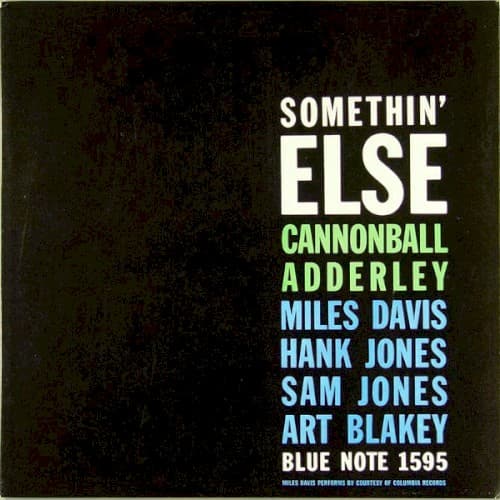
The scorecard
8.5/10 · Essential
- Composition20%
- 8.5
- Recording15%
- 9.5
- Performance30%
- 9.0
- Cohesion15%
- 7.5
- Originality10%
- 7.0
- Replay value10%
- 8.5
The standards are recast with new approaches, and the title blues finds a groove that sustains eight minutes without overstaying.
Rudy Van Gelder's recording at his Hackensack studio puts every instrument in clear relief: Blakey's cymbals, Jones' touch, the brass in the same room.
Davis plays with middle-period authority and Adderley counters with warmer phrasing; the rhythm section is elegant but too restrained.
Five tracks, thirty-nine minutes, sequenced well, though the short closer feels abbreviated after three long centerpieces.
The material is familiar and the approach is conservative; what is new is the pairing and the specific reimagining of the standards.
The interplay between Davis and Adderley rewards repeated listens, and Van Gelder's sound has aged better than most late-fifties Blue Notes.
Cannonball Adderley Somethin' Else — Miles Davis Plays Second Chair and Steals the Date
The oddity of Somethin' Else is in the billing. This is Cannonball Adderley's only Blue Note album as a leader, recorded in March 1958 while he was a member of Miles Davis' first great quintet, yet Davis dominates the session. He takes most of the opening solos, composed the title track, and according to the liner notes chose most of the material. The result is less an Adderley reveal than a hard bop standards date where two horn players of different temperaments work through five songs with one of the best rhythm sections Blue Note could assemble. The thesis here is that the album succeeds not because of any single vision but because the pairing itself creates tension: Davis plays with the cool jazz lyricism of his middle period, Adderley answers with a warmer, bluesier attack, and the contrast gives familiar tunes new angles.
Recorded at Rudy Van Gelder's Hackensack studio shortly after Davis had finished Milestones, the session leans toward standards and one original blues. Hank Jones on piano, Sam Jones on bass, and Art Blakey on drums provide the foundation, though Blakey is asked to stay in the pocket rather than drive the band. The repertoire includes two Cole Porter standards, a Dietz-Schwartz ballad, and Davis' twelve-bar Somethin' Else, plus Nat Adderley's One for Daddy-O written for a Chicago DJ. The question the album must answer is whether a conservative program played by a quintet this strong can justify its place in the catalog when none of the players are leading with their most distinctive ideas. It can, because the interplay is specific and the recording is immaculate, but the album sits just outside the essential tier: great performances of good arrangements, not a statement.
Two Horns, One Room, No Competition
The strength of Somethin' Else is in how clearly the session was recorded and how well the two horns complement each other without competing. Van Gelder's engineering puts Davis and Adderley in the same acoustic space with no bleed or murk: the trumpet is centered and immediate, the alto is warm and slightly to the left, and the rhythm section sits behind them in clean separation. Jones' piano has the bell-like clarity that marks Van Gelder's best work from this period, and Blakey's cymbals shimmer without washing out the bass. The room sound is close but not dry, and the result is that every phrase and response is audible. This is the album at its most straightforward: five musicians playing standards in a room, no gimmicks, no effects, just the performance.
Davis and Adderley divide the solo space unevenly, with Davis taking the first statement on most tracks and setting the tone. His playing here is the middle-period style heard on Milestones and the modal sketches that would lead to Kind of Blue: lyrical, spare, and rhythmically patient. He leaves space and he phrases behind the beat, which gives Jones and the rhythm section room to breathe. Adderley follows with a fuller, more vocalized sound, closer to the blues and to Parker's phrasing, and the contrast between the two approaches is what makes the album work. On Autumn Leaves, Davis plays the theme with a searching quality that treats the changes as something new, while Adderley digs into the melody with more assurance. On the title blues, Davis lays back and Adderley pushes forward, and the dialogue between them sustains eight minutes without dragging.
The rhythm section is elegant but underutilized. Hank Jones plays with taste and precision, most clearly on the introduction to Love for Sale, but he is not given much solo space and his accompaniment is often too polite. Blakey, one of the era's most propulsive drummers and a hard bop pioneer, is asked to keep time rather than drive, and while he does it well the album never shifts into the hard-swinging mode that defined his own Blue Note dates. Sam Jones is solid but not prominent. The conservatism of the session is deliberate—this is a blowing date, not a display for the rhythm section—but the result is that the album feels more restrained than the personnel would suggest. The lack of a single weak performance raises the floor, but the lack of real fire keeps the ceiling lower than it could have been.
Thirty-Nine Minutes, One Short Closer, No Filler
The album runs thirty-nine minutes across five tracks, and the sequencing is logical: two long standards open each side, with the shorter closer ending the program. The pacing works because the longer tracks are spaced out and because the variety in tempo and mood prevents monotony. The first half features ten and seven minute performances respectively, both mid-tempo and both built around the interplay between Davis and Adderley. The second half fills with two twelve-bar blues treatments, the first lean and modal, the second more traditional. The final track, at just over four minutes, feels like an afterthought rather than a conclusion, but it does not drag and it does not overstay.
The album earns its length on the first stretch and loses momentum only at the end. The long takes on the opening numbers sustain interest because the soloists build ideas rather than coast, and because the rhythm section keeps the pulse alive without pushing. One for Daddy-O ends with Davis addressing producer Alfred Lion directly, asking if that was the take he wanted, which breaks the fourth wall and reminds the listener that this was a working session, not a constructed statement. The bonus track Bangoon, added in the eighties and misidentified as Alison's Uncle, is a decent performance but not essential, and the alternate take adds nothing. The original five-track program is the album.
A Second-Tier Blue Note Classic, Worth Hearing for the Pairing
Somethin' Else ranks as a strong hard bop session and a demonstrate for two contrasting horn players at different points in their careers, but it is not among the essential Blue Note albums of the late fifties. It lacks the compositional ambition of Davis' own Milestones or the rhythmic urgency of Blakey's Moanin', recorded the same year. What it offers instead is immaculate sound, elegant performances, and a pairing that works because the two leaders do not try to outplay each other. Davis plays with the authority of someone who had already recorded dozens of sessions as a leader, Adderley responds with a warmer and bluesier approach, and the result is a conversation rather than a competition. The album has aged well because Van Gelder's recording is transparent and because the performances do not lean on gimmicks or trends that dated quickly.
This is an album for listeners who want to hear Davis and Adderley together in a relaxed setting, and for anyone interested in how standards were being reimagined in the late fifties before modal jazz became the dominant mode. It is not the place to start with either artist: Davis' own Kind of Blue and Adderley's later Mercy, Mercy, Mercy! are more representative and more essential. Skip this if you want the hard-driving rhythm section that Blakey brought to his own dates, or if you want the compositional adventurousness that Davis and Adderley would pursue elsewhere. Start with Autumn Leaves and Somethin' Else to hear the pairing at its best, then decide if the conservatism of the session holds up for the full program. For fans of either artist this is a worthwhile detour; for everyone else it is a well-recorded example of a style that other albums executed with more urgency.
Track by track
Track Listing
Autumn Leaves
StandoutDavis opens with the theme, phrasing behind the beat and treating the melody as something fragile, and Adderley follows with a fuller statement that digs into the changes. The contrast between the two approaches is the track's reason for existing: Davis plays with space and restraint, Adderley plays with warmth and a blues inflection, and the rhythm section supports both without favoring either. Hank Jones comps with taste, Blakey keeps a light swing, and the track sustains nearly eleven minutes because the soloists build ideas rather than run changes. Davis credits Ahmad Jamal for the treatment in the liner notes, and the influence is audible in the use of space and the attention to dynamics. This is the album's most complete performance, the one that earns its length and rewards repeat listens. The alternate take added on later reissues is slower and less focused, and it adds nothing.
Love for Sale
SolidHank Jones plays an elegant introduction that showcases his touch and his harmonic sense, then the band settles into a medium-up tempo that suits both horns. Davis plays the first solo with his middle-period lyricism, spare and rhythmically patient, and Adderley follows with a bluesier attack. The track works because the rhythm section is more active here than elsewhere on the album, with Blakey pushing slightly and Sam Jones walking with more presence. The performance is solid but not revelatory, and it suffers from comparison to the Davis Sextet version recorded two months later, which benefits from a fuller arrangement and a more adventurous rhythm section. This is a good take of a standard, nothing more.
Somethin’ Else
StandoutDavis composed this twelve-bar blues and it bears his fingerprints: modal, spare, and built around a simple riff rather than a complex head. The track is the album's centerpiece and its longest performance at over eight minutes, and it sustains that length because the soloists play with restraint and the rhythm section locks into a groove that does not waver. Davis solos first, playing long tones and leaving space, and Adderley answers with a warmer, more vocalized approach that fills the gaps. Hank Jones takes a brief solo that is tasteful but too short, and Blakey stays in the pocket throughout, never shifting into the hard-driving mode that would have pushed the track into a different register. The conservatism is deliberate and the track works on its own terms, but it is not the blues workout that Blakey's own dates would deliver. At the end of One for Daddy-O, Davis can be heard asking producer Alfred Lion if the take was what he wanted, which suggests that the session was more collaborative than the billing implies.
One for Daddy‐O
SolidNat Adderley wrote this twelve-bar blues for Chicago radio DJ Holmes Daddy-O Daylie, and it is a more traditional blues than the title track, with a singable head and a straightforward groove. Adderley plays with more authority here than anywhere else on the album, leaning into the blues changes with a vocalized tone, and Davis follows with a cooler, more detached solo that contrasts effectively. The rhythm section is solid but not adventurous, and the track would have benefited from Blakey being allowed to push the tempo or break up the groove. The performance is professional and well-recorded, but it does not add much to the album's argument. At the end of the take, Davis addresses Alfred Lion directly, asking if that was the take he wanted, which breaks the fourth wall and reminds the listener that this was a working session.
Dancing in the Dark
WeakThe Dietz-Schwartz ballad closes the album at just over four minutes, and it feels like an afterthought rather than a conclusion. Davis plays the melody with his trademark lyricism, Adderley takes a brief solo, and the track ends without building to a climax or making a final statement. The performance is competent but abbreviated, and it does not provide the resolution that the album's longer centerpieces deserve. This is the one track that could have been left off without weakening the program.