The scorecard
8.0/10 · Great
- Composition20%
- 8.5
- Recording15%
- 9.0
- Performance30%
- 8.0
- Cohesion15%
- 7.0
- Originality10%
- 8.0
- Replay value10%
- 7.5
The themes are spacious and designed for group interplay rather than harmonic density, with "La Fiesta" in particular building frameworks that allow the rhythm section to lead the improvisation.
Manfred Eicher's signature ECM clarity gives each instrument its own space in the stereo field, capturing Purim's voice and Moreira's percussion with presence while keeping Clarke's bass centered and tactile.
The ensemble plays with patience and listens closely, though Farrell's solos sometimes lean on stock bebop phrases rather than developing ideas particular to these compositions.
The twenty-three minute side two medley earns its length through shifting textures and sustained invention, but the shorter first side feels like sketches rather than a complete statement.
The album moves electric jazz away from the rock-derived grooves of most 1972 fusion and toward a lighter Latin and Brazilian inflection that would define ECM's jazz aesthetic for years.
The title track and the medley reveal new details in the rhythm section's interplay on repeat listens, though the middle two tracks serve more as mood pieces than destinations.
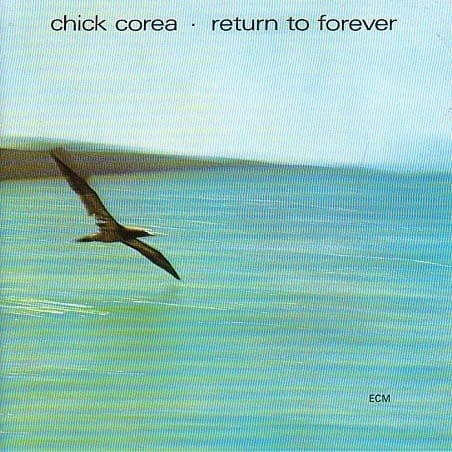
Chick Corea Return to Forever — When Fusion Learned to Float
Most electric jazz in 1972 arrived heavy, built on backbeats and distortion. Chick Corea's Return to Forever, recorded in February for ECM but held back from American release until 1975, proved that fusion could work at half the weight. Where Miles Davis and Weather Report were thickening the rhythms and layering the electric timbres, Corea assembled a quintet around voice, flute and Latin percussion and let space do as much work as the notes. The result is an album that sounds less like jazz-rock than like a Brazilian daydream played on electric instruments, and it opened a path that ECM would follow for decades.
The album's achievement is primarily in texture and ensemble feel rather than in composition. Corea's themes are simple, sometimes to the point of thinness, and the real writing happens in the arrangements: how Flora Purim's wordless vocals interweave with Joe Farrell's flute, how Stanley Clarke's bass anchors without pushing, how Airto Moreira's percussion colors the edges instead of driving from the center. The question is whether this approach produces music worth the forty-seven minutes, or whether it substitutes atmosphere for argument. The answer depends on which tracks you mean.
The Sound of Air and Strings
The instrumentation tells you what Corea was after. No drums, just Moreira on percussion. No acoustic piano, just the soft bell of the Fender Rhodes. Farrell almost entirely on flute and soprano saxophone rather than tenor.
Clarke on electric bass for three tracks and upright for the final medley. Purim singing without words, her voice treated as another lead instrument rather than as a focal point. Manfred Eicher's production, spare even by ECM standards, gives each player room in the stereo field and allows the silences to register. You hear the physical presence of the instruments: the breath in the flute, the snap of the bass strings, the skin of the drums.
The result is a recording that sounds like a small room even when the music opens up, and that clarity is the album's greatest technical achievement.
The compositional approach is modal and repetitive, closer to the structures Corea was developing with his acoustic groups than to the through-composed fusion that would define the electric Return to Forever lineups after 1973. The title track sets a vamp on the Rhodes and lets the ensemble float variations over it for twelve minutes, the tension coming from how the players phase in and out of the groove rather than from harmonic movement. "Crystal Silence" is even stiller, a duet in all but name with Corea and Purim trading phrases while the rhythm section marks time. The writing is minimal by design, and the test is whether the playing fills what the compositions leave open.
Sometimes it does. Clarke's bass work throughout is inventive within the constraints, finding melodic lines that support without crowding and anchoring the rhythm without locking it down. Moreira's percussion, layered and textured rather than groove-driven, gives the music a sense of motion even in the slower passages. Purim's vocals, entirely without lyrics, function as a lead voice that can state themes and improvise with the same fluidity as the horns, and her interplay with Farrell is the ensemble's most consistent strength.
Farrell himself is the weak link. His flute playing is competent and sometimes lovely, but his soprano solos rely too often on bebop vocabulary that sits uneasily against the modal frameworks, and he rarely develops ideas across the length of a solo the way the rhythm section develops grooves.
The production is ECM jazz in its purest form, before the label's aesthetic became a cliché. Every instrument is captured with detail and separation, the Rhodes ringing with a clean sustain, the bass present and physical, the percussion spread across the stereo image. The dynamic range is wide, and the recording rewards close listening in a way that most fusion records of the period, compressed for radio and built for volume, do not. What the sound cannot do is add weight to music that sometimes needs it.
Length and the Problem of the Sketch
The album is backloaded. Side one runs twenty-three minutes across three tracks, all of them pleasant and none of them essential. The title track establishes the band's language and shows what the instrumentation can do, but it circles its ideas rather than pushing through them, and twelve minutes is too long for music that does not develop. "Crystal Silence" is the album's most delicate moment, a duet feature for Corea and Purim that earns its quietness, but it fades rather than ends. "What Game Shall We Play Today" is four and a half minutes of vamp that could be half that length without losing anything.
Side two is the twenty-three minute medley "Sometime Ago / La Fiesta", and this is where the album justifies its existence. The first half, "Sometime Ago", opens with Purim singing over minimal accompaniment, building slowly as the rhythm section enters and Clarke's bass takes on more melodic responsibility. The transition into "La Fiesta" is gradual, the tempo lifting and Moreira's percussion becoming more insistent, and the final ten minutes of the suite are the album's strongest playing. Clarke switches to upright bass and the ensemble locks into a 6/8 groove that allows for both momentum and space, Farrell's soprano finally finding a context where his lines make sense, and the written theme is strong enough to support the improvisations. The medley earns its length by shifting textures and sustaining a single arc of development, and it shows what the band could do when the compositions matched the players.
The sequencing is a problem. Putting the three shorter pieces on side one makes that half feel like a warm-up, and the album does not cohere as a single statement so much as it builds to a climax on the second side and leaves the first as a set of sketches.
A Document of a Direction, Not a Destination
Return to Forever is a transitional album that matters more for what it made possible than for what it achieved. It moved electric jazz away from the rock grooves that dominated fusion in 1972 and toward the lighter Latin and Brazilian textures that ECM would mine for the rest of the decade, and it demonstrated that a fusion group could work without a drummer and still generate momentum. The influence is audible in everything from the later ECM catalog to the Brazilian-inflected fusion that followed. But as a record to return to, it is uneven. The title track and "Crystal Silence" are pretty but slight, and only the medley on side two has the compositional substance to match the ensemble's interplay.
This is an album for listeners who want to hear where ECM's jazz sound came from, and for fans of Clarke and Purim who want to hear them in a context that foregrounds their strengths. It is not the place to start with Corea's fusion work; that would be the electric Return to Forever albums that followed, which took the Latin grooves and the ensemble chemistry and added harmonic density and more decisive writing. Listeners coming from the rock side of fusion will find the album too quiet and too repetitive, and those coming from acoustic post-bop may find the electric timbres too thin to carry the modal frameworks. Start with "Sometime Ago / La Fiesta" to hear what the band could do when the composition met the playing, then work backward through the shorter tracks if the approach appeals. For the next step, try the heavier Return to Forever lineups or Flora Purim's solo work from the mid-1970s, where her voice gets more space to lead. This is a record that opened doors, and it is more interesting for that fact than for what is on the other side of them.
Track by track
Track Listing
Return to Forever
SolidThe title track opens the album and establishes the instrumentation and the aesthetic in one twelve-minute statement. Corea sets a modal vamp on the Rhodes, the chords ringing with the instrument's clean sustain, and the ensemble enters gradually: Purim's voice wordless and floating, Farrell's flute doubling and harmonizing, Clarke's electric bass anchoring with a melodic line that moves under the harmony rather than locking to the root. Moreira's percussion is light and layered, more texture than pulse, and the groove breathes rather than drives. The theme is simple, almost a children's melody, and the development is collective rather than solo-driven, the players phasing in and out of the foreground. The music is pleasant and the interplay is clear, but the track circles its ideas for twelve minutes without pushing through to a second level, and the lack of harmonic or rhythmic development makes the length feel unearned. It works as an introduction to the band's language, but it is not strong enough to carry the weight of being the album's longest single piece.
Crystal Silence
SolidThe quietest track on the album, a duet in all but name between Corea's Rhodes and Purim's voice, with Clarke and Moreira marking time in the background. The melody is delicate and the harmonic movement is minimal, the piece floating on sustained chords and allowing silence to do as much work as the notes. Purim's voice is treated with the same clarity as the piano, her phrases unhurried and her tone pure, and the interplay between voice and Rhodes is the album's most refined moment. The track earns its stillness, but it fades rather than ends, and the lack of a stronger conclusion makes it feel like a sketch that was never completed. Beautiful in the moment, but it does not hold up as a destination.
What Game Shall We Play Today
WeakA four-and-a-half minute vamp that serves more as a transition than as a fully realized piece. Farrell's flute states the theme, a playful modal line that could have come from a children's song, and the rhythm section supports with a light groove that never quite commits to a direction. The track has a tentative quality, as if the band is feeling out the material rather than performing it, and the brevity is a mercy. It does not add much to the album and could have been left as a studio warm-up. Filler.
Sometime Ago / La Fiesta
StandoutThe album's centerpiece and its justification, a twenty-three minute medley that builds slowly and earns its length. "Sometime Ago" opens with Purim singing over minimal accompaniment, her voice carrying the melody with Clarke's bass entering quietly underneath, and the music expands gradually as Corea's Rhodes and Moreira's percussion add layers. The theme is simple but the arrangement is patient, allowing each texture to register before the next arrives, and the transition into "La Fiesta" is gradual, the tempo lifting and the rhythm section shifting from accompaniment to co-lead. Clarke switches to upright bass and the ensemble locks into a 6/8 groove, the written theme strong enough to support extended improvisation. Farrell's soprano finally finds a context where his bebop vocabulary fits, the rhythmic drive allowing his lines to land rather than float, and the interplay between Clarke's bass and Moreira's percussion generates momentum that the earlier tracks lacked. The final ten minutes are the album's best playing, the ensemble sustaining invention across multiple solo sections and returning to the theme with conviction. The medley is the only track that feels like a complete statement rather than a sketch, and it shows what the band could do when the composition matched the players' strengths. Essential.