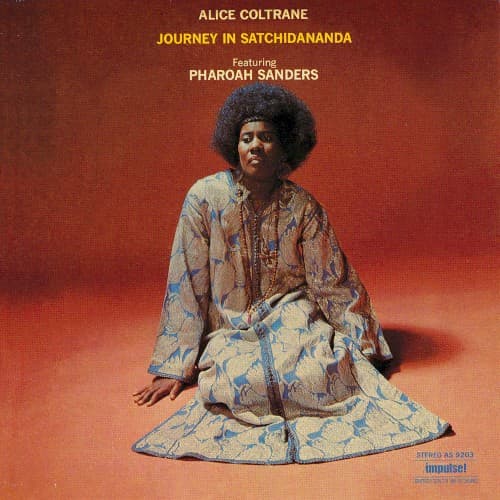
The scorecard
8.9/10 · Essential
- Composition20%
- 9.0
- Recording15%
- 8.5
- Performance30%
- 9.5
- Cohesion15%
- 8.0
- Originality10%
- 9.0
- Replay value10%
- 8.5
The compositions create open frameworks centered on single modes or pedal points, giving soloists endless space to explore without losing direction.
The home studio recordings capture the harp with unusual presence and balance Sanders without letting him dominate, though the live track shows minor bleed.
Sanders and Coltrane sustain long modal explorations without lapsing into repetition, finding new phrases and textures across extended durations.
The four studio pieces form a coherent set, but the live closer shifts the palette abruptly with oud and a different bass chair.
The tanpura and harp combination applied to modal jazz creates a sound no one else was making in 1970, bridging idioms without imitation.
The patience required on first listen becomes the point on repeat, revealing how much happens inside Sanders' circular phrases and the unchanging drones.
Alice Coltrane Journey in Satchidananda — Modal Jazz as Prayer
The thesis is in the drone. Journey in Satchidananda opens with a tanpura holding a single pitch, not as atmosphere but as the foundation for everything that follows: Pharoah Sanders' soprano saxophone enters over it, then Alice Coltrane's harp, both playing variations on the same mode with no chord changes and no predetermined length. The piece lasts over six minutes, but the form is circular, not developmental. It could end at three minutes or continue for twenty, and the structural logic would hold. That choice, to build compositions around sustained tones and cyclic patterns rather than harmonic progression, is what makes this album work as spiritual practice instead of spiritual decoration.
Coltrane recorded the first four tracks at home in Dix Hills in November 1970, less than three years after John Coltrane's death, with Sanders, bassist Cecil McBee, drummer Rashied Ali, and two additional players on tanpura and small percussion. The final track, recorded live at the Village Gate, substitutes Charlie Haden on bass and adds Vishnu Wood on oud. The difference in setting matters less than the consistency of approach: every piece prioritizes space and repetition over variety, asking soloists to sustain focus across long durations without falling into cliché. Sanders, who had played with John Coltrane and was known for high-energy free jazz, plays almost entirely in the upper register here, often circling a handful of pitches for minutes at a time. That restraint is the album's central tension, the discipline required to stay inside a single mode until the mode reveals something.
Composition as Framework, Improvisation as Meditation
The writing sets parameters without dictating content. The title track establishes a drone on D, with the tanpura providing harmonic reinforcement and the harp outlining scalar patterns that suggest Mixolydian or Dorian mode without committing to Western functional harmony. Sanders enters with a motif built from stepwise motion and small intervals, repeating and varying it across the entire performance. The effect is hypnotic in the specific sense: the repetition lowers resistance to what happens inside each iteration. Coltrane's harp solo follows the same principle, her phrases moving through the mode with more rhythmic variation than Sanders but the same commitment to the tonal center. The rhythm section, Ali on drums and McBee on bass, plays responsively rather than setting up grooves, keeping time without subdividing it into patterns that would pull focus from the soloists.
On Shiva-Loka, Coltrane switches to harp again and the mode shifts slightly, but the structure remains the same: a pedal tone, a simple scale, soloists exploring it for the duration. The recording, done in her home studio, balances the harp against Sanders' soprano without losing either instrument. The harp has presence and body, not the thin upper-register shimmer it sometimes gets in orchestral settings, and Sanders sits in the mix rather than cutting through it. Stopover Bombay, at under three minutes, functions as a brief interlude, Coltrane on harp alone with minimal accompaniment, the shortest track but no less committed to the same tonal stasis.
Something About John Coltrane, the longest studio piece, puts Coltrane on piano and draws directly from her late husband's compositional language, building on themes he had used in his own modal work. The piano allows her more harmonic density than the harp, but she uses it sparingly, often letting phrases ring out over silence or playing single-note lines that mirror Sanders' approach. The piece sags slightly in the middle, the improvisations running longer than the material can sustain without risk of sameness, a rare moment where the patience the album demands tips toward endurance test.
The live recording of Isis and Osiris introduces the oud, played by Vishnu Wood, and shifts the tonal palette toward Middle Eastern modes. Haden replaces McBee on bass, and his time feel, more grounded and less elastic than McBee's, anchors the performance differently. The oud adds textural contrast but also pulls the piece in a slightly different direction than the studio tracks, more overtly referencing North African and Arabic musical traditions rather than Indian classical music. The shift is jarring in sequencing terms, a break from the consistency of the first four tracks.
Pacing Built on Patience, Not Peaks
The album's flow depends on accepting that nothing peaks in the conventional sense. The title track sets the terms, and the next three studio pieces deepen them without changing the approach. There are no climaxes, no shifts to double-time, no moments where the band collectively raises the intensity and then brings it back down. The energy level stays roughly constant, and the listener's experience changes not because the music does but because sustained attention to repetition alters perception. That works for the first four tracks, which share the same recording environment and instrumental palette and feel like variations on a single idea.
Isis and Osiris, placed last, breaks the pattern. The oud and the live setting introduce variables that the earlier tracks had deliberately excluded, and while the performance is strong, it does not feel like a culmination of what came before. The sequencing would be stronger if the album ended with Something About John Coltrane or if the live track had been recorded with the same instrumentation as the studio sessions. As it stands, the album's second half feels slightly bifurcated, the clearest piece of evidence that this is a transitional work rather than a fully realized statement.
A Turning Point That Defines the Path
Journey in Satchidananda ranks as essential early spiritual jazz, the album where Coltrane synthesized Indian classical principles, modal jazz, and the influence of Swami Satchidananda into a working method that would guide her output for the next decade. It is not the most advanced version of that method—later albums push further into abstraction and devotional framing—but it is the clearest articulation of the core idea: that jazz improvisation and meditative practice can operate by the same logic, sustaining focus on a single tonal center until the center opens up.
This is for listeners who can sit with long modal explorations without needing release or resolution, and who want to hear Sanders in a restrained mode rather than the ecstatic intensity of his work with John Coltrane or his own mid-seventies records. It is not for anyone looking for variety in texture or form, and the short runtime of Stopover Bombay and the stylistic shift of Isis and Osiris mean the album does not achieve the total consistency it reaches for. Start with the title track and Shiva-Loka, which are the purest examples of the approach. If those hold attention, the rest of the album earns its length. From here, move to Coltrane's later Impulse Records albums or to Sanders' work on Karma, which takes the same modal work and pushes them toward more overt spiritual fervor. Journey in Satchidananda proves that jazz can function as prayer without borrowing surface exoticism, by making repetition the structure rather than the decoration.
Track by track
Track Listing
Journey in Satchidananda
StandoutThe title track establishes the album's method in full: a tanpura drone on D, Sanders circling a narrow range of pitches in the soprano's upper register, and Coltrane's harp moving through scalar patterns without harmonic progression. The piece lasts over six minutes, but the form is cyclic, not linear. Sanders plays motifs built from stepwise motion and returns to them with slight variations, never straying far from the tonal center. Coltrane's harp solo follows the same principle, her phrases outlining the mode with more rhythmic variety than Sanders but the same commitment to repetition. Ali and McBee provide support without imposing structure, keeping time but avoiding settled grooves that would divide the performance into sections. The recording captures the harp with unusual clarity, giving it body and presence rather than ethereal shimmer. This is the clearest example of Coltrane's approach on the album, patient and focused, built to sustain attention across long durations without relying on dynamic shifts or harmonic movement.
Shiva‐Loka
StandoutColtrane remains on harp, and the mode shifts slightly from the opener, but the structural logic holds: a pedal tone, a scale, soloists exploring it for the duration. Sanders again plays in the upper register, his phrases circling a few pitches and varying the rhythm more than the melody. The interplay between harp and saxophone is more conversational here than on the title track, Coltrane responding to Sanders' phrases with complementary lines rather than waiting for him to finish. The rhythm section stays responsive, Ali adding texture without settling into patterns. The home studio recording balances the instruments well, Sanders sitting in the mix rather than dominating it. The piece runs over six minutes and earns the length, finding enough variation within the limited harmonic material to avoid stasis. It demonstrates the same patience as the opener but with slightly more rhythmic interplay.
Stopover Bombay
SolidThe shortest track, under three minutes, functions as an interlude. Coltrane plays harp with minimal accompaniment, outlining a mode with spare phrases and leaving space between them. The piece references the trip to India and Sri Lanka she was planning, but it does not attempt to imitate Indian classical music directly. Instead, it applies the same principles of tonal stasis and cyclic repetition in a briefer, more skeletal form. The brevity keeps it from developing into anything substantial, and it feels like a sketch rather than a finished composition. It works as a pause between longer pieces but does not stand on its own.
Something About John Coltrane
SolidThe longest studio track, running nearly ten minutes, puts Coltrane on piano and draws directly from themes her late husband had used in his own modal work. The piano gives her access to more harmonic density than the harp, but she uses it sparingly, often playing single-note lines that mirror Sanders' melodic approach or letting chords ring out over silence. Sanders plays with the same restraint as on the earlier tracks, circling narrow intervals and building solos from repetition and slight variation. The piece sags in the middle, the improvisations running longer than the thematic material can sustain without risk of sameness. The rhythm section, McBee and Ali, stays responsive, but the absence of a clear structural midpoint makes the performance feel more like an extended vamp than a composed piece. The final minutes regain focus, Coltrane returning to the main theme and bringing the piece to a quiet close. It is the weakest of the studio tracks, stretching the approach past its natural length, but it demonstrates Coltrane's ability to channel her husband's compositional language without imitating his performance style.
Isis and Osiris
StandoutRecorded live at the Village Gate, this track introduces the oud, played by Vishnu Wood, and shifts the tonal palette toward Middle Eastern modes. Haden replaces McBee on bass, and his time feel, more grounded and less elastic, anchors the performance differently than the studio tracks. Coltrane plays harp, and Sanders remains on soprano saxophone and percussion. The oud adds textural contrast but also pulls the piece in a different direction than the first four tracks, more overtly referencing North African and Arabic musical traditions rather than Indian classical music. The modal framework remains the same—a pedal tone, a scale, soloists exploring it—but the timbre and the live setting change the character of the performance. The piece runs over eleven minutes, the longest on the album, and the improvisations sustain focus without lapsing into repetition. Sanders plays with more intensity here than on the studio tracks, his phrases occasionally pushing into the altissimo register, and Coltrane's harp responses are more rhythmically active. The live recording introduces some bleed between instruments, and the balance is less controlled than on the home studio tracks, but the performance is strong. The shift in instrumentation and setting makes it feel like a separate statement rather than a continuation of the album's first half, a choice that disrupts the sequencing but also demonstrates Coltrane's interest in expanding her harmonic and timbral range.