The scorecard
8.8/10 · Essential
- Composition20%
- 9.0
- Recording15%
- 7.5
- Performance30%
- 9.5
- Cohesion15%
- 8.0
- Originality10%
- 9.5
- Replay value10%
- 8.5
Compositions move between odd meters and unison themes with precision that maps new territory for ensemble fusion.
Captures the intensity but the separation between instruments can blur in dense passages, losing individual lines.
McLaughlin and the band execute breakneck passages with absolute control while maintaining hair-trigger interplay.
Eight tracks flow through spiritual themes and dynamic arcs though the middle section sags slightly before recovering.
Fuses jazz improvisation with rock aggression and Indian rhythmic concepts in ways no prior group had attempted.
The virtuosity remains astonishing across listens but the relentless intensity can exhaust before the final track.
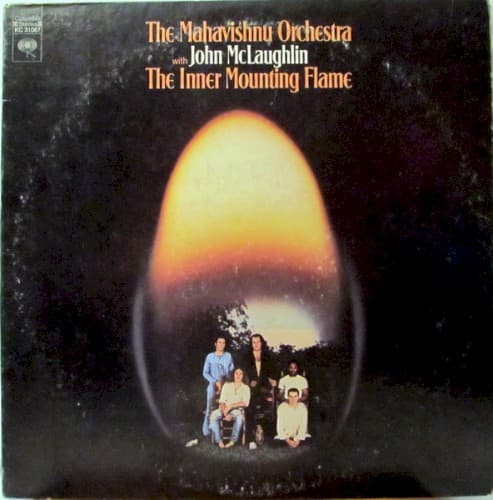
The Mahavishnu Orchestra The Inner Mounting Flame — The Algebra of Ecstasy
The question this album poses is whether a jazz ensemble can play with rock intensity at compositional complexity that would make most bebop rhythm sections quit, and the answer arrives eleven seconds into the opening track when the band locks into a unison theme that shifts meters while accelerating toward a guitar solo that sounds like it is trying to escape its own fretboard. What makes The Inner Mounting Flame more than a technical demonstration is that the compositions are actual structures rather than blowing vehicles: the themes matter, the transitions are written, and the improvisations emerge from harmonic and rhythmic frameworks that give the intensity somewhere to go besides louder.
The stakes in 1971 were whether electric instruments and high volume could serve compositional ambition or whether fusion meant watering down either jazz or rock to meet in a tasteful middle. This band chose a third path: use the electricity for speed and attack, then write material that requires both. The result feels less like jazz-rock than like a new organism, one that shares Indian classical music's interest in extended rhythmic cycles and modal exploration but moves at the velocity of a power trio. Where most fusion of the moment either sweetened the groove or settled into static vamps, these eight tracks keep reconfiguring themselves, treating the arrangement as a kind of controlled detonation.
The spiritual titles and concepts frame the music but do not dictate it; this is not background music for meditation unless the meditation involves calculating time signatures at high speed. The question the album leaves is whether this approach has room to grow or whether it can only be this specific thing done at this specific temperature, and the subsequent catalog would wrestle with that limit. Here, before the question needed answering, it simply exists as a coherent and ferocious debut.
Velocity as Compositional Material
The writing uses speed and metric complexity not as effects but as the substance of the music. Meeting of the Spirits opens with that unison theme in an odd meter, then fragments into a guitar solo that moves through modes while the rhythm section shifts beneath it, never settling into a static groove. The theme returns as a anchor, not a verse-chorus. A Lotus on Irish Streams builds on a quieter modal theme with space for the violin, but even there the arrangement keeps moving between written ensemble passages and open soloing. The compositional method across the album is to write precise unison lines and rhythmic figures that frame improvisation rather than simply setting up blowing sections over a vamp.
The guitar tone is overdriven but articulate, with enough clarity to make the scalar runs and chord voicings audible even at high velocity. The violin cuts through with a brightness that contrasts the guitar's sustain, and the two voices trade lines or double each other depending on the section. The keyboard adds harmonic clusters and occasional lead lines but mostly functions as part of the rhythm section, thickening the ensemble sound. The drumming is the engine: complex, propulsive, shifting between rock-derived intensity and jazz ride patterns without treating either as the default. The bass anchors it all while often playing written lines rather than walking or grooving in a conventional sense.
The production captures the attack and the ensemble balance well enough to make the arrangements intelligible. The issue is that in the densest passages, particularly when guitar and violin are both soloing over active drumming and keyboard, the stereo image can smear and individual lines become harder to follow. It is not a fatal flaw but it means moments that should sound like three conversations happening in counterpoint instead sound like one very loud argument. The quieter sections like Dawn expose the individual instruments more clearly and show how precise the interplay is when the volume drops.
The weakness is that the relentless forward motion leaves little room for dynamics within a track. The Noonward Race is essentially one long sprint with no meaningful change in energy from start to finish, and while the playing is notable, the effect is exhausting rather than exhilarating by the third minute. The Dance of Maya has a similar problem: it sets a tempo and intensity level and maintains them without variation, so the six-minute duration feels arbitrary rather than earned. The album works best when it builds or shifts, and weakest when it simply sustains.
Architecture of Combustion
The sequencing alternates between explosive and contemplative, which prevents the album from becoming monotonous even as individual tracks sometimes do. The opening statement establishes both the compositional approach and the performance standard. The first interlude pulls the intensity down and lets the violin explore a melodic line without competition. Then the middle section pushes hard but feels slightly redundant; the second of those tracks does not add much that the first has not already demonstrated, and the pacing sags.
The modal gentleness recovers the variety midway through, and the closing run works because it escalates again after the breathing room. The arc is functional rather than inevitable: the album clearly front-loads its strongest material and relies on sheer intensity to carry the middle stretch, but it does not collapse. The length is reasonable at eight tracks and under forty-five minutes, though cutting one of the mid-tempo burners would have tightened it.
The album does not have an obvious single or entry point in the conventional sense; the opener is the logical start and the penultimate track might be the most immediately gripping, but this is a record that asks for full engagement rather than offering easy highlights. That is both a strength and a limit.
The Problem It Solved and the Problem It Created
The Inner Mounting Flame sits among the handful of albums that proved electric fusion could be compositionally serious and rhythmically adventurous without sacrificing intensity, placing it alongside work that would emerge from Miles Davis and Weather Report in the same period but solving the problem differently. Within the Mahavishnu catalog it is the purest statement of the original concept before the band expanded or softened. It has aged as a document of a specific moment when this kind of precision-at-speed felt like new information, and it still sounds startling in that regard. The risk is that later fusion internalized these ideas and delivered them with better production and more dynamic range, which can make this feel like the sketches for a language others would later speak more fluently.
This is for listeners who want to hear where a particular strand of fusion started and who have the patience for relentless intensity that does not always justify its own length. It is not for someone looking for groove-based fusion or for accessible entry points into jazz. Start with Meeting of the Spirits and You Know You Know to hear the concept at full strength, then decide whether the full album rewards the commitment. Skip it if you need space and dynamics within tracks rather than just between them, or if the spiritual framing suggests the music will be meditative rather than combative.
If this connects, the next step is to hear how Miles Davis approached electricity and ensemble complexity on a record like Bitches Brew, which chose very different compositional structures to solve similar problems, or to investigate later Mahavishnu work to hear where this approach could and could not evolve. The Inner Mounting Flame is the founding document of a method that was both hugely influential and almost impossible to repeat, even for the band that invented it.
Track by track
Track Listing
Meeting of the Spirits
StandoutThe opening unison theme announces the album's intentions in the first fifteen seconds: odd meter, precision ensemble playing, and a willingness to use speed as a compositional element rather than a stunt. When the theme breaks and the guitar solo begins, the rhythm section keeps shifting underneath, moving through different feels without ever settling into a static vamp. The violin enters to trade lines with the guitar and the two voices push each other higher before returning to the theme. The structure is clear, the playing is ferocious, and it establishes the template the rest of the album will follow. This is the essential track and the one that defines what the band is attempting.
Dawn
SolidA brief interlude built on a violin melody over sustained keyboard and light percussion. It functions as necessary breathing room after the intensity of the opening and demonstrates that the band can play quietly, though the composition itself is slight. The track exists to create dynamic contrast in the sequence rather than to stand alone, and it succeeds at that limited purpose.
The Noonward Race
SolidA high-energy piece that establishes a fast tempo and rides it for nearly seven minutes without significant variation. The guitar and violin both solo over the relentless rhythm section, and the playing is technically impressive, but the track does not develop or build so much as it sustains a single intensity level until it stops. The lack of internal dynamics or structural shifts makes it feel longer than its actual duration. This is the first sign that the compositional approach has limits when a track does not have a strong enough theme or enough sections to justify the length.
A Lotus on Irish Streams
StandoutThe album's quietest and most lyrical piece, built on a modal theme that gives the violin extended melodic space. The guitar plays chordal accompaniment and brief responses rather than dominating, and the rhythm section supports rather than drives. The composition is simple but effective, and the restraint is welcome in the sequence. It reveals how articulate the players are when they are not playing at maximum volume and speed. The track works because it offers genuine contrast rather than just a different tempo, though it does not reach the compositional depth of the more complex pieces.
Vital Transformation
WeakAnother high-intensity burner that revisits territory The Noonward Race has already covered. The unison theme is strong and the solos are committed, but the track does not add new information or explore a different compositional idea. By the time it reaches its midpoint it starts to feel redundant, and the album's weakest stretch is this middle section where two similar tracks sit too close together. The playing remains excellent but the writing does not justify another six-plus minutes at this energy level.
The Dance of Maya
StandoutA complex theme in an odd meter with strong ensemble writing and effective transitions between written sections and open solos. The composition is more developed than the previous two burners, with actual sections that create a sense of structure rather than just a launch pad for improvisation. The guitar solo is one of the album's most sustained and coherent, building ideas rather than simply running scales. The track earns its length better than Vital Transformation does, though it still tilts toward the exhausting by the end.
You Know You Know
StandoutThe most immediately gripping track on the album, with a unison theme that is both memorable and rhythmically tricky, and a structure that keeps shifting between ensemble hits and open blowing. The energy is high but the composition has enough hooks and transitions to prevent it from becoming monotonous. The interplay between guitar and violin is at its sharpest here, with the two voices finishing each other's phrases and pushing the intensity higher without losing clarity. This is the track that best balances the band's technical ambition with actual listenability, and it makes the case for the album as emphatically as the opener.
Awakening
SolidA closing track that reprises some of the album's themes and concepts without introducing new material. It functions as a summary and a final statement, circling back to the unison-line-into-open-solo structure that Meeting of the Spirits established. The playing is strong and the track provides a sense of closure, but it feels more like an epilogue than a climax. It is not filler but it is also not essential, serving the sequence better than it would stand alone.