The scorecard
8.1/10 · Great
- Composition20%
- 8.5
- Recording15%
- 7.5
- Performance30%
- 9.0
- Cohesion15%
- 7.0
- Originality10%
- 7.5
- Replay value10%
- 8.0
"Medieval Overture" and "The Magician" demonstrate sophisticated composition where written themes and rapid unison lines create frameworks that demand and reward virtuosic ensemble playing.
Dennis MacKay's recording at Caribou Ranch captures Corea's arsenal of keyboards with clarity and places Di Meola's guitar and Clarke's bass in distinct space, though the drums occasionally recede in the mix.
The extended solos on "The Romantic Warrior" and Corea's keyboard showcase on "Duel of the Jester and the Tyrant" display the interplay of a band at its technical peak, with Clarke and Di Meola matching Corea's velocity.
The medieval concept and consistent energy hold the album together, but forty-five minutes of unrelenting virtuosity creates fatigue, and "Majestic Dance" feels like a detour into straight rock.
The answer to Wakeman's prog concept albums brings medieval themes and layered synthesizers into jazz fusion, though the formula of fast unison runs and extended solos was already Return to Forever's signature.
The compositions reveal new details on repeat listens as individual lines emerge from the unison passages, though the sheer technical density can be exhausting over multiple plays.
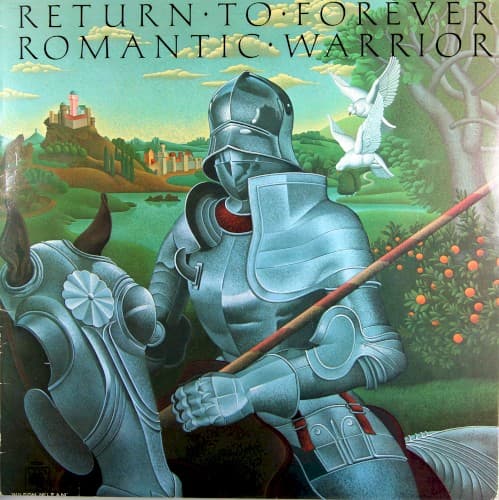
Return to Forever Romantic Warrior — When Fusion Answered Prog and Won
Romantic Warrior settles the question of whether jazz fusion could match progressive rock's conceptual ambition and instrumental firepower: it could, and it did not need twenty minutes of keyboard solos to prove it. Recorded in February 1976 at Caribou Ranch in Colorado, this album took Rick Wakeman's medieval pageantry from The Myths and Legends of King Arthur and reframed it as a highlight for four musicians who could execute rapid unison lines at speeds most rock bands could not imagine. Where Wakeman's concept relied on orchestral sweep and lyrical storytelling, Chick Corea's answer was six instrumental pieces built on intricate themes, syncopated rhythms and solos that treated the concept as a setting rather than a script. The result was Return to Forever's first album for Columbia Records, their most commercially successful release, and the final statement from the quartet that defined the second wave of fusion.
The thesis here is that Romantic Warrior succeeded not by out-progging the prog rockers but by keeping the jazz in jazz fusion: the compositions are tight, the improvisations are structured, and the interplay between Corea, Al Di Meola, Stanley Clarke and Lenny White is the point. The medieval themes and synthesizer layers gave the album a marketable identity and separated it from the funk-leaning fusion that dominated the mid-seventies, but the real achievement is in the execution. Every track except the title piece is built on fast, precise ensemble playing where a single missed note would collapse the arrangement, and the solos emerge from the written material rather than pausing it. The album earned gold certification and reached number 35 on the Billboard 200, numbers that no other Return to Forever release matched, because it delivered prog-level spectacle without abandoning the rhythmic and harmonic complexity that made fusion worth listening to in the first place.
Velocity as Composition, Keyboards as Orchestra
Romantic Warrior is an album of frameworks designed to be played at the edge of technical capability. Corea wrote the opener, the title track, and the closer, and each one sets up a different challenge: "Medieval Overture" establishes melodic motifs that recur throughout the album, "The Romantic Warrior" is a fully acoustic piece with long solo sections, and "Duel of the Jester and the Tyrant" stretches to eleven minutes and builds to an intense keyboard display. The compositions are not simple; they demand exact synchronization across multiple instruments, and the rapid unison lines that appear in "The Magician" and the title track require Clarke's bass, Di Meola's guitar and Corea's keyboards to lock in at speeds where a sixteenth note's hesitation would be audible. The writing is less about melody than about creating intricate patterns that sound inevitable once you have heard them but would be nearly impossible to reconstruct from memory.
Corea's keyboard arsenal, as detailed in the credits, included ARP Odyssey, Micromoog, Minimoog, Moog 15 modular and Polymoog synthesizers, plus Fender Rhodes, Hohner Clavinet, Yamaha organ, acoustic piano and marimba. The layering is most effective on "Sorceress," where the synthesizers create a funky riff that anchors Lenny White's drums and gives Di Meola space to play over the top, and on "Majestic Dance," where the harpsichord-like synth figures contrast with Di Meola's distorted guitar. Dennis MacKay's recording captures the keyboards with clarity, and the individual timbres remain distinct even when Corea is layering multiple synths in the same passage. The acoustic piano on "The Romantic Warrior" is warm and present, and Clarke's Alembic bass with Instant Flanger has enough body to hold the low end without muddying the keyboards.
Di Meola's guitar and Clarke's bass are the other compositional voices. Di Meola contributed "Majestic Dance," which relies on rock riffs and a distorted lead tone that feels like a detour into straight prog rather than fusion. The track has energy and the synth figures are clever, but it is the least interesting piece on the album because it abandons the interplay that defines the rest of the record. Clarke's "The Magician" is more successful: the playful melodies and rapid unison lines create a composition that feels like a puzzle being solved in real time, with each instrument contributing a piece of the solution. White contributed "Sorceress," the funkiest track on the album, and his drums and timpani anchor the rhythm section throughout. The weakness is that White's role is often to keep time while the other three players execute the written lines and solos; there are few moments where the drums are given thematic material to develop, and on the faster tracks the cymbals occasionally recede in the mix.
The album is exhausting by design. Forty-five minutes of this level of technical density, with only "The Romantic Warrior" offering a slower tempo, creates fatigue. The medieval concept holds the tracks together, but the sequencing does not give the listener room to breathe, and by the time "Duel of the Jester and the Tyrant" reaches its keyboard climax, the impact is diminished because the preceding five tracks have already delivered multiple climaxes. The album would have been stronger with one fewer track or with a clearer contrast in dynamics between the pieces.
Six Movements, One Unrelenting Argument
The album sequence is a test of how much virtuosity a listener can absorb before the technical feats start to blur together. The opening stretch sets the mood efficiently, introducing motifs that return later and establishing the synthesizer-heavy palette. The shift into funk gives White a groove to work with, and the contrast between the two openers suggests that the album might vary its approach. It does not.
The title track, at nearly eleven minutes, is the longest stretch of acoustic playing on the record, and the extended intro and outro create space around the solos, but the fast unison patterns in the outro bring the intensity back to the level of the opening tracks. Side two continues the argument without changing it. The first piece on the second half feels like filler; the rock riffs and distorted guitar tone are competent but not essential, and the harpsichord synth figures are a clever idea that does not develop into anything substantial. The following stretch restores the focus with its complex structure and playful interplay, and the closing run delivers the album's most conventional melody alongside its most intense keyboard solo.
The sequencing is relentless: there is no ambient interlude, no stripped-down acoustic moment beyond the title track, and no track that exists to reset the energy level. The pacing works if you are listening for the sheer display of skill, but it makes the album feel like a single forty-five-minute movement rather than six distinct pieces. By the end of the back half, the impact is cumulative rather than climactic; the album has made its point three times over, and the final minutes do not add a new argument.
The Fusion Peak Before the Breakup
Romantic Warrior is the best argument for jazz fusion as a genre that could compete with prog rock on ambition and exceed it on musicianship. It is also the sound of a band that had perfected its formula and had nothing left to prove, which explains why Corea disbanded this lineup immediately afterward. The album ranks as the essential Return to Forever release because it captured the quartet at the peak of its technical ability and because it found a concept that gave the virtuosity a marketable frame. It is for listeners who want to hear what four of the best fusion players of the seventies could do when the compositions demanded absolute precision, and it is not for anyone who finds extended displays of technique exhausting. The weaknesses are real: the sequencing creates fatigue, "Majestic Dance" is a detour, and the album's relentless intensity works against the medieval concept that was supposed to give it variety.
Start with "Medieval Overture" to understand the album's architecture, then jump to "The Romantic Warrior" for the acoustic interplay and the extended solos. If those two tracks work, the rest of the album will deliver more of the same at higher speeds. Skip "Majestic Dance" unless you need to hear every track. For the next album, try earlier Return to Forever records like Hymn of the Seventh Galaxy for a rawer version of the same quartet, or explore the similarly intense work of Mahavishnu Orchestra for comparison. Romantic Warrior is the endpoint of a specific version of fusion, the moment when the genre's technical possibilities were fully explored and the only question left was whether to repeat the formula or move on. Corea chose to move on, and the album stands as the definitive statement from a band that proved fusion could be as disciplined and as ambitious as any other instrumental music of its era.
Track by track
Track Listing
Medieval Overture
StandoutThe album's thesis statement in five minutes: melodic motifs introduced on synthesizers, rapid ensemble lines that establish the level of precision required for everything that follows, and a mood that justifies the medieval concept without leaning on it too heavily. Corea's layered keyboards create the orchestral sweep that prog audiences expected, but the motifs are tight and economical, not expansive. The track works as an overture because it previews the album's vocabulary without attempting to summarize it, and the length is exactly right. The synthesizer tones are clean and the arrangement is busy without feeling cluttered, though the track's function is more atmospheric than argumentative. It sets up the stakes and steps aside.
Sorceress
StandoutLenny White's composition is the funkiest moment on the album and the clearest contrast to the speed-focused writing that dominates the other tracks. The opening riff is syncopated and groove-driven, and Corea's synthesizers play off the rhythm rather than racing over it. White's drums and percussion are more prominent here than anywhere else on the record, and the track creates space for individual voices to emerge rather than locking everyone into unison lines. Di Meola's guitar work is fluid and the bass line holds steady, but the track sags slightly in the middle section where the funk riff repeats without developing. The synthesizer layers are dense but not as interesting as the interplay in the rhythm section, and by the seven-minute mark the track feels like it has made its point. Still, the funkier approach offers a break from the relentless velocity elsewhere, and the composition gives White a chance to contribute something beyond timekeeping.
The Romantic Warrior
StandoutThe only fully acoustic track and the longest stretch of solo space on the album. The intro is patient, building slowly before the short theme enters, and the theme itself is just one riff repeated and elaborated. Corea, Di Meola and Clarke each take extended solos, and the interplay is where the track succeeds: Clarke's bass solo is rhythmically inventive and harmonically adventurous, Di Meola's acoustic guitar work is clean and percussive, and Corea's piano solo develops the theme without simply restating it. The outro brings the fast unison patterns back, and the shift from the spacious solo sections to the tight ensemble playing in the final minutes demonstrates the band's range. The acoustic palette is a relief after the synthesizer density of the first two tracks, and the extended length is earned because the solos reveal different facets of the written material. The track's weakness is that the theme is too simple to support ten minutes; the solos carry the weight, and when they end the track ends.
Majestic Dance
WeakAl Di Meola's composition is the album's weakest link. The rock riffs and distorted lead guitar tone are competent but generic, and the harpsichord-like synth figures are a clever textural idea that never develops into a musical argument. The track relies on energy rather than composition, and while the fast synth runs and the guitar distortion create momentum, there is no interplay and no complexity beneath the surface. It feels like a detour into straight prog rock, the genre Romantic Warrior was supposed to be answering, and the five-minute runtime feels longer because the riff does not evolve. White's drums are solid and the production is clear, but the track contributes nothing to the album's thesis and could have been cut without weakening the sequence. If you are listening for the jazz in jazz fusion, skip this one.
The Magician
StandoutStanley Clarke's composition is the most playful piece on the album and one of the most technically demanding. The melodies are intricate and the rapid unison lines require exact synchronization, but the writing never feels like a technical exercise because the playful quality keeps the music from becoming mechanical. Clarke's bass drives the composition, and the piccolo bass tone adds brightness to the lower register. Corea's keyboards and Di Meola's guitar weave around the bass line, and the unison passages are tight enough that individual instruments are hard to distinguish, which is the point. The track is complex without being forbidding, and the five-and-a-half-minute length is ideal; it makes its argument and moves on. The rhythm section interplay is stronger here than on "Majestic Dance," and the composition has enough internal variety to justify repeated listens. One of the album's highlights.
Duel of the Jester and the Tyrant, Parts I & II
SolidThe longest track and the album's climax, though by the time it arrives the cumulative effect of the preceding five tracks has dulled the impact. The main theme is more conventional than the motifs in "Medieval Overture" or the unison lines in "The Magician," and the melody is almost singable, which makes it accessible but less interesting. The track follows the established formula: fast ensemble sections, extended solos, and a return to the theme. Corea's keyboard solo is the most intense moment on the album, layering synthesizers and acoustic piano in a showcase that demonstrates his technical range, but the solo arrives after ten minutes of similar material and the context diminishes its force. The Parts I and II structure does not create a clear division; the track reads as one continuous eleven-minute piece that could have been tightened. The outro brings the album to a definitive close, but the sense of conclusion is more about exhaustion than resolution. A strong composition that suffers from sequencing.