The Architect of Modern Jazz: Miles Davis's Enduring Revolution
Miles Davis didn't just play jazz — he redefined it five times over across a career that spanned from the bebop era through fusion's zenith. Born in 1926 in Alton, Illinois and raised in East St. Louis, Davis arrived in New York in 1944 ostensibly to study at Juilliard but quickly dropped out to chase the music happening in 52nd Street clubs. By 1945, he was recording with Charlie Parker. By his death in 1991, he had fundamentally reshaped jazz's sonic possibilities more than any other single figure.
What makes Davis's career remarkable isn't longevity but reinvention. Where most artists find a signature sound and refine it, Davis demolished his own aesthetic every decade. The cool, understated approach of Birth of the Cool gave way to the hard bop urgency of 'Round About Midnight, which yielded to the modal spaciousness of Kind of Blue, which evolved into the abstract explorations of his second great quintet, which exploded into the electric maelstrom of Bitches Brew. Each phase attracted disciples and outraged purists.
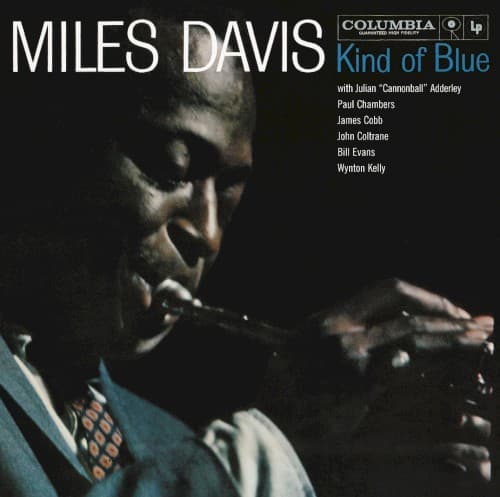
His influence extends beyond jazz into rock, hip-hop, and electronic music. His 1959 masterpiece Kind of Blue remains the best-selling jazz album in history, introducing modal improvisation to a mass audience. But Davis never rested on past achievements. He spent his final two decades chasing contemporary sounds, collaborating with Marcus Miller and incorporating funk, soul, and even hip-hop elements. The man who defined cool in the 1950s was sampling scratching techniques by the 1980s.
The Sound of Space: Miles Davis's Evolving Trumpet Voice
Davis's trumpet tone was his signature — a middle-register voice that prioritized melody over technical fireworks, space over density. Unlike the acrobatic bebop trumpeters he emerged alongside, Davis played fewer notes with greater intention. His sound was burnished, vulnerable, occasionally fragile. He used the Harmon mute extensively, creating that distinctive pinched, intimate tone that became synonymous with introspection in jazz. Listen to his solo on "So What" from Kind of Blue: each phrase breathes, leaving room for silence to amplify the next statement.
This restraint was strategic, not technical limitation. Davis possessed formidable chops when he chose to deploy them, but he understood that silence could be as expressive as sound. His phrasing drew from vocalists — he cited Orson Welles's voice as an influence — and he shaped melodic lines with a singer's attention to dynamics and emotional arc. Where other trumpeters announced their presence, Davis drew listeners in, forcing attention through intimacy rather than volume.
His approach to bandleading mirrored his instrumental philosophy: hire the best musicians, establish minimal frameworks, then get out of their way. He rarely rehearsed extensively, preferring to capture spontaneous interaction in the studio. This philosophy yielded extraordinary results with his various quintets and sextets, creating environments where John Coltrane, Bill Evans, Herbie Hancock, Wayne Shorter, and Tony Williams could push boundaries while Davis provided directional gravity. His bands functioned as postgraduate programs for jazz innovation.
Five Revolutions: Tracing Miles Davis's Transformative Decades
Davis's first major statement came with Birth of the Cool sessions recorded in 1949-1950, though not released as an album until 1957. Working with arranger Gil Evans and a nine-piece ensemble, Davis pioneered a lighter, more orchestrated alternative to bebop's frenetic energy. The cool jazz movement that followed owed its existence to these recordings, which demonstrated that sophistication didn't require speed.
The 1950s brought heroin addiction, a brief career decline, and a triumphant comeback. His 1955 performance at the Newport Jazz Festival led to a contract with Columbia Records that would last three decades. His first great quintet — featuring John Coltrane, Red Garland, Paul Chambers, and Philly Joe Jones — established the hard bop template with albums like 'Round About Midnight and Milestones. But Davis was already moving beyond chord-change-based improvisation toward modal approaches that would define his next phase.
Kind of Blue, recorded in 1959 with Bill Evans, Coltrane, Cannonball Adderley, Chambers, and Jimmy Cobb, stands as his most influential achievement. The album's modal framework — using scales rather than chord progressions as improvisational foundations — opened new territories for jazz exploration. Its five tracks, recorded in just two sessions with minimal rehearsal, captured a moment of collective genius. "So What" alone revolutionized how jazz musicians approached composition, its two-mode structure inspiring countless imitators while remaining inimitable in execution.
The 1960s brought his second great quintet with Wayne Shorter, Herbie Hancock, Ron Carter, and Tony Williams — arguably the most adventurous small group in jazz history. Albums like E.S.P., Miles Smiles, and Nefertiti pushed toward abstraction while maintaining groove and accessibility. This band operated telepathically, deconstructing standards and originals into new shapes nightly. Williams's polyrhythmic drumming, Shorter's angular compositions, and Hancock's harmonic innovations gave Davis freedom to explore his most elliptical phrasing.
Then came the electric period. In a Silent Way (1969) and Bitches Brew (1970) obliterated the acoustic/electric divide, incorporating rock rhythms, electronic keyboards, and studio editing techniques. Jazz purists revolted, but Davis had found a new audience. His fusion albums sold hundreds of thousands of copies and influenced rock musicians from Jimi Hendrix to Joni Mitchell. He toured with larger ensembles featuring multiple keyboardists and percussionists, creating dense, groove-oriented soundscapes that bore little resemblance to his earlier work. Critics accused him of selling out; he responded that music either moved forward or died.
After a five-year retirement from 1975-1980, Davis returned with a more explicitly pop-oriented sound. Albums like Tutu (1986), produced by Marcus Miller, featured synthesizers, drum machines, and contemporary production aesthetics. This late period remains controversial among purists but demonstrated Davis's lifelong commitment to evolving rather than calcifying into a living museum piece.
The Miles Davis Effect: How One Trumpeter Shaped Sixty Years of Music
Davis's alumni roster reads like a jazz hall of fame: John Coltrane, Bill Evans, Cannonball Adderley, Herbie Hancock, Wayne Shorter, Chick Corea, Keith Jarrett, John McLaughlin, Joe Zawinul, Tony Williams. Nearly every significant jazz innovator from 1955-1975 passed through his bands, learning his philosophy of restraint, space, and fearless reinvention. The schools of modal jazz, post-bop, and jazz fusion all trace directly to Davis's innovations.
Beyond jazz, his influence permeates contemporary music. Hip-hop producers have sampled his work extensively — "So What" alone has been interpolated dozens of times. Rock guitarists cite his electric period as foundational. Electronic musicians reference his willingness to embrace technology. His approach to leadership — surrounding yourself with talent, establishing vision, then trusting collaborators to execute — remains a model across creative fields.
Kind of Blue's cultural penetration is unprecedented for a jazz album. It has sold over five million copies, appears on countless "greatest albums" lists regardless of genre, and serves as the entry point for millions discovering jazz. Its influence on ambient music, film scoring, and even meditation playlists demonstrates how Davis's vision of spacious, modal improvisation transcended jazz's boundaries. The album proved that experimental music could achieve popular success without compromise.
Yet Davis's most profound legacy may be philosophical rather than musical. He demonstrated that artists could refuse to repeat themselves, that commercial success need not dictate creative direction, and that evolution was essential to vitality. He never looked back, rarely performed his classic material, and showed open contempt for nostalgia. This forward-looking stance — sometimes arrogant, always uncompromising — established a model of artistic integrity that transcends genre. Miles Davis didn't preserve jazz traditions. He obliterated and rebuilt them repeatedly, proving that tradition's highest expression is transformation.