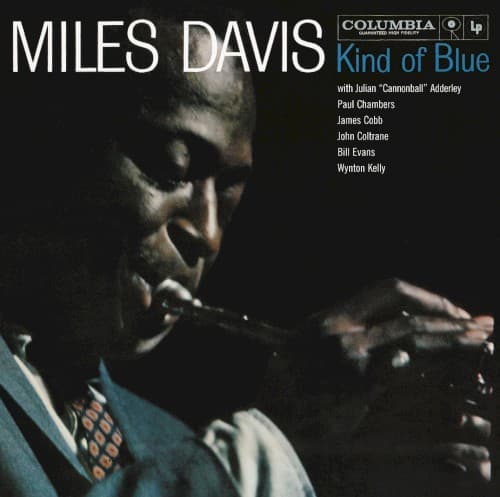
The scorecard
9.7/10 · All-time
- Composition20%
- 10.0
- Recording15%
- 9.5
- Performance30%
- 10.0
- Cohesion15%
- 9.0
- Originality10%
- 9.5
- Replay value10%
- 10.0
Modal frameworks on all three tracks give improvisers open fields without the usual chord fences, and every sketch earns its length.
Columbia's 30th Street Studio captures the sextet with clarity and room: Evans's piano sits close enough to hear the key action, Chambers's bass has body and definition, and Cobb's cymbal work shimmers without washing out the horns.
Davis plays with economy and space that makes every phrase count, Coltrane pushes modal possibilities further than anyone had on record, Evans shapes silence as carefully as sound, and the rhythm section breathes as one organism.
Three tracks chosen for this truncated tracklist flow from the conversational opener through the ballad interlude to the waltz closer, though the full album's five-track arc is obviously stronger.
Modal jazz existed before this session but no one had committed an entire album to it with this level of execution, and the improvisational freedom it unlocked changed what was possible in a recording studio.
Six decades later it remains the second-best-selling jazz album in the United States and the introductory record for generations of listeners, holding up on the thousandth listen as it did on the first.
Miles Davis Kind of Blue — How Jazz Learned to Leave Space
The argument for Kind of Blue is audible in the first eight bars of the opening track. Davis gives the rhythm section a two-note motif, a vamp so plain it barely qualifies as a melody, and then the horns state the theme in unison: a question without an answer, a door left open. What follows is nine minutes of improvisation built not on a chord progression but on a single scale, and every player finds something different in that openness. Coltrane stacks phrases in long, searching lines.
Adderley swings hard and stays melodic. Davis plays fewer notes than anyone and every one of them lands. The result is a conversation, not a contest, and the space between the notes matters as much as the notes themselves.
Recorded in two sessions at Columbia's 30th Street Studio in March and April 1959, the album was Davis's answer to bebop's thicket of chord changes. Where Parker and Gillespie had built solos by navigating harmonic obstacle courses, Davis wanted melody and breathing room. Modal jazz, based on scales rather than chords, gave improvisers freedom to shape lines without watching the clock.
Davis had tested the idea on Milestones the year before, but Kind of Blue committed to it completely. The sextet—Coltrane and Adderley on saxophones, Bill Evans on piano for all but one track, Paul Chambers on bass, Jimmy Cobb on drums—showed up with sketches, not arrangements, and recorded most of the master takes without a second pass. The lack of rehearsal was not a gimmick; it was the method. Davis wanted first-thought improvisations, and what the band delivered in those two days became the template for modal playing and the best-selling jazz album in history for decades.
Scales as Invitations, Not Instructions
The modal framework does most of its work by getting out of the way. On the three tracks presented here, the compositions are sketches in the literal sense: a scale, a mood, a length. Davis told the band what to play on, not what to play, and the difference is everything. Modal improvisation removes the harmonic checkpoints that bebop soloists used as anchors, which means the player has to generate momentum and direction from melody alone. The risk is aimlessness; the reward is clarity. All three tracks here take the reward.
A Sequence Built on Contrasts
The three-track selection here is a compressed version of the album's arc, but the pacing still works.
Where It Ranks and Who Should Start Here
Kind of Blue sits at the top of Davis's catalog, the clearest distillation of his ideas about space and melody, and the only album of his that sold in the millions without a single electric instrument. It is also the most accessible entry point in his discography and in modal jazz generally: the compositions are melodic, the improvisations are easy to follow, and the relaxed tempos give the listener room to hear what each player is doing. For someone new to jazz, this is the record that explains why improvisation matters. For someone who already knows the genre, it is the standard against which modal playing is still measured.
The album's only weakness is that it makes modal jazz sound easier than it is, which has led to decades of imitators who mistake space for silence and simplicity for depth. The real lesson of Kind of Blue is not that fewer chords mean more freedom, but that freedom requires discipline. Every player here knows exactly what to leave out, and that knowledge came from years of playing bebop's complex changes. The modal approach was not a rejection of bebop's technique; it was a way of using that technique toward different ends.
For listeners new to the album, start with
Track by track
Track Listing
So What
StandoutThe opener is the album's thesis statement and its most influential track. The form is simple: a two-note bassline, eight bars of D Dorian, eight bars of E-flat Dorian, eight bars back to D. The theme, played in unison by the horns, is more a signal than a melody, and the solos that follow prove how much can be built on a single scale. Evans solos first, staying close to the theme and using space as punctuation. Davis follows with a solo that is all architecture: each phrase lands in a different part of the scale, and the silences between them let the ideas settle. Coltrane takes the opposite approach, playing long, unbroken lines that test the limits of the mode, and Adderley brings the energy back to swing, quoting blues phrases without ever sounding trad. Chambers and Cobb hold the rhythm without pushing, and the result is a performance that feels both composed and spontaneous. The track's influence is impossible to overstate: every modal composition since 1959 has had to reckon with how much Davis and this band did with so little material.
Blue in Green
StandoutThe ballad is the album's quietest and most delicate track, a ten-measure cycle with a four-measure introduction that Evans claimed to have written or co-written, a claim the Davis estate later acknowledged. The form is unusual—ten bars instead of the standard eight, twelve, or sixteen—and the melody is a descending figure that never quite resolves. Evans plays the introduction alone, and his touch is so light that the piano sounds like it is whispering. Davis enters with a solo that is all restraint: long tones, careful placement, and phrases that end on notes the ear does not expect. Coltrane follows with a solo that leans into the harmonic ambiguity, bending notes and stretching time, and the rhythm section responds by pulling back even further. The track is only five and a half minutes, but it feels longer because every note is weighted. The weakness is that the form's brevity works against the improvisations: just as a soloist finds a direction, the cycle ends and the next player starts. It is a sketch that might have benefited from more development, but what is here is still among the most beautiful recordings in Davis's catalog.
All Blues
StandoutThe closer is a twelve-bar blues in 6/8 time, which gives the familiar form a rolling, almost lazy feel. The head is built on a simple riff that the horns play in unison, and the solos follow the blues structure with modal coloring: the changes are there, but they are softened, and the improvisers spend more time on the scales than on the chord tones. Davis opens with a muted solo that swings without rushing, and Adderley follows with a harder-edged statement that leans into the blues tradition. Coltrane's solo is the peak: he takes the 6/8 rhythm and plays against it, stacking triplets and double-time runs that push the groove without breaking it. Evans comps with block chords that thicken the harmony, and Chambers walks a bassline that anchors the rhythm while Cobb's brushwork keeps the energy simmering. The track is nearly twelve minutes and earns every second of it, proof that modal jazz can swing as hard as bebop without the harmonic density. It is also the most immediately satisfying piece on the album, the one that works on the first listen and deepens with each return.