The scorecard
9.7/10 · All-time
- Composition20%
- 10.0
- Recording15%
- 9.0
- Performance30%
- 10.0
- Cohesion15%
- 9.5
- Originality10%
- 9.5
- Replay value10%
- 9.5
The four-movement suite structure and the four-note motif that anchors "Acknowledgement" create a compositional frame rigorous enough to hold thirty-three minutes of intense improvisation without losing shape.
Van Gelder's recording places the quartet in a shared space where Garrison's bass anchors the bottom, Tyner's piano sits left of center, and Jones's drums fill the room without crowding Coltrane's tenor, though the gong strike that opens the album sits oddly prominent.
Coltrane's solo on "Acknowledgement" moves from the motif through thirty-six repetitions of the four-note phrase to the chanted vocal overdubs with complete structural control, and the quartet's interplay across all four movements sustains the spiritual intensity without breaking.
The suite flows from the motif-building of "Acknowledgement" through the ascending energy of "Resolution" and "Pursuance" to the wordless recitation of "Psalm" with deliberate pacing, and at thirty-three minutes the length is exactly what the structure requires.
Recording a through-composed suite as an explicit spiritual statement in four parts, with the leader chanting the title phrase over his own overdubs and performing a devotional poem on tenor saxophone, had no direct precedent in jazz in 1965.
The four-note motif and the architectural clarity of the suite make the album immediately graspable, and the improvisations reveal new details on repeat listens, though the intensity and the devotional framing ask for attention that not every listen can provide.
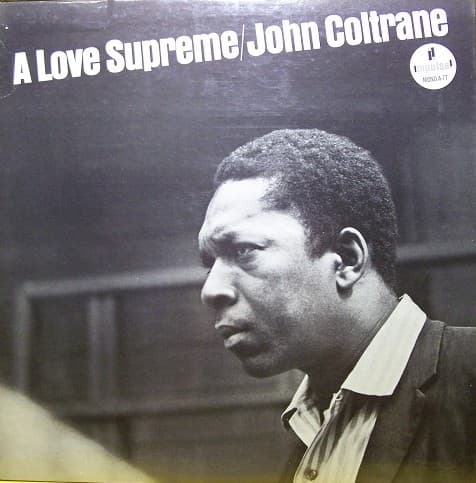
John Coltrane A Love Supreme — Four Parts, One Prayer
A Love Supreme argues that jazz improvisation can carry the weight of devotion when the compositional frame is strong enough to hold it. Recorded in one session on December 9, 1964, at Van Gelder Studio with the quartet of McCoy Tyner, Jimmy Garrison and Elvin Jones, the album is a through-composed suite in four parts built on a four-note motif that Coltrane repeats, inverts, extends and finally chants as the title phrase. The structure is the point: the suite gives the intensity somewhere to go, and the four movements map a progression from acknowledgement through resolution and pursuit to a wordless recitation of a devotional poem that Coltrane performs on tenor saxophone. The result is thirty-three minutes that function as both a masterclass in quartet interplay and a statement of spiritual purpose clear enough that a church in San Francisco adopted it as a central text.
The stakes are whether the devotional framing enhances the music or merely frames it. Coltrane had been moving toward longer forms and spiritual themes since 1961, but A Love Supreme makes the connection explicit in the liner notes and in the structure itself, and the explicitness invites skepticism. The album sold half a million copies by 1970 against Coltrane's usual thirty thousand, became a touchstone for the counterculture and influenced musicians from Carlos Santana to U2, and by 2020 it appeared on nearly every list of essential jazz albums. The question is not whether the quartet plays at the highest level—the evidence is audible throughout—but whether the suite structure and the devotional intent make the album more than the sum of four extended improvisations. The answer is yes, because the four-note motif and the four-part architecture give the improvisations a cumulative force that no single movement could achieve on its own.
How the Motif Becomes the Structure
The compositional engine is the four-note motif that Jimmy Garrison plays on bass in the opening seconds of "Acknowledgement": a descending phrase simple enough to transpose through all twelve keys, which Coltrane does over the course of the movement. The motif is both the melodic foundation and the harmonic roadmap, and Coltrane's solo spends seven minutes building outward from it in widening intervals and rhythmic variations until he repeats the four notes thirty-six times in a row, at which point the motif becomes the chant "a love supreme," sung by Coltrane in overdubbed layers nineteen times. The structure is more rigorous than it sounds: the repetition is not trance but demonstration, proof that the motif can support the weight of the solo and the weight of the devotional statement without collapsing into either formula or chaos.
Van Gelder's recording captures the quartet in a shared acoustic space with Garrison's bass anchored low in the mix, Tyner's piano slightly left of center, and Elvin Jones's drums spread across the stereo field without crowding Coltrane's tenor. The balance allows the interplay to register clearly: Tyner's modal voicings give Coltrane room to move without providing explicit harmonic direction, and Jones's polyrhythmic drumming creates momentum without forcing the tempo. The gong strike that opens "Acknowledgement" sits oddly prominent in the mix, more theatrical than musical, but the rest of the recording prioritizes clarity over atmosphere. The weakness is that Van Gelder's close-miked approach sometimes flattens the dynamic range, so that the quieter passages in "Psalm" lack the spatial depth that the devotional framing suggests.
"Resolution" and "Pursuance" are the suite's two most conventional movements, built on modal vamps that allow the quartet to stretch out. "Resolution" opens with an ascending theme that Coltrane plays in a slower, more lyrical register than the opening movement, and Tyner's solo builds from sparse chordal statements to dense clusters that push against the modal frame. "Pursuance" is the fastest and most aggressive movement, with Jones driving the tempo and Coltrane soloing in the sheets-of-sound style that defined his work in the late fifties and early sixties. The movement peaks with a drum solo that clears space for the final section, though the transition into "Psalm" is abrupt enough that the suite briefly loses momentum.
"Psalm" is the most structurally unusual movement: Coltrane performs a wordless recitation of the devotional poem printed in the liner notes, playing the poem's phrases on tenor saxophone in a style that mirrors the cadences of African-American preaching. The solo is not abstract; it follows the poem line by line, ending with the words "Elation. Elegance. Exaltation. All from God. Thank you God. Amen," which Coltrane plays in descending phrases that resolve on a held note.
How the Suite Earns Its Length
The suite's pacing is front-loaded: "Acknowledgement" does the compositional work, "Resolution" and "Pursuance" build intensity, and "Psalm" functions as a coda that steps outside the quartet's usual improvisational mode. The sequencing is deliberate, and the thirty-three-minute length is exactly what the four-movement structure requires, but the flow between movements is uneven. The transition from "Acknowledgement" to "Resolution" is smooth, with the ascending theme of the second movement answering the motif of the first, but "Pursuance" peaks early and the drum solo stretches longer than the movement can support. By the time "Psalm" begins, the suite has spent twenty-five minutes at high intensity, and the wordless recitation asks the listener to shift modes from quartet interplay to solo meditation. The shift works thematically but not always musically: "Psalm" is more interesting as a structural idea than as six minutes of listening.
The suite sags in the middle third of "Pursuance," where the quartet's energy begins to feel repetitive rather than cumulative. Coltrane's solo covers familiar ground, and Jones's drumming, brilliant in the first half of the movement, starts to dominate the mix in a way that crowds out Tyner and Garrison. The suite recovers in "Psalm," but the loss of momentum in "Pursuance" raises the question of whether a tighter edit would have served the structure better. The album's length is modest by the standards of Coltrane's later work, but the four-movement structure depends on each movement earning its place, and "Pursuance" does not quite meet that standard.
Where It Stands and Who Should Start Here
A Love Supreme is the most perfectly plotted single piece of jazz Coltrane recorded, the album where the compositional ambition and the quartet's improvisational power align completely. It ranks as the essential Coltrane studio album for listeners who want to hear the spiritual intensity and the structural rigor in the same recording, and it is the best entry point for anyone who finds the late-sixties free jazz recordings too abstract. The suite structure makes the album more accessible than the freewheeling improvisation of the live recordings from the same period, and the four-note motif gives the listener something to follow even when Coltrane's solos move into dense harmonic territory. The devotional framing will matter to some listeners and not to others, but the music does not require belief to work: the quartet plays at the highest level throughout, and the suite holds together on purely musical terms.
The weaknesses are real but minor. "Pursuance" stretches longer than its material supports, and "Psalm" is more successful as a concept than as a performance. The album has aged into an untouchable cultural artifact, and the reverence sometimes obscures the fact that it is not Coltrane's most adventurous or his most emotionally raw recording. The live recordings from 1965 and 1966 push further into atonality and collective improvisation, and the studio albums that followed A Love Supreme—Ascension, Meditations—are more uncompromising in their rejection of conventional structure. But no other Coltrane album combines ambition, accessibility and execution as completely as this one, and no other album has carried the same weight for listeners who come to jazz looking for something beyond craft.
Start with "Acknowledgement" for the four-note motif and the chant, then "Psalm" for the wordless recitation. If those two movements work, play the suite straight through. For the next album, hear Giant Steps for the harmonic innovation in a more conventional quartet format, or go straight to the 1965 live recording from Antibes to hear how the suite changes in front of an audience.
Track by track
Track Listing
A Love Supreme, Part 1: Acknowledgement
StandoutThe movement that makes the album essential. Garrison's four-note motif arrives after a gong strike and cymbal wash, and Coltrane spends the first four minutes building variations on the phrase, transposing it through all twelve keys in a demonstration of how much melodic and harmonic material a simple motif can generate. The solo is patient, methodical, never frantic, and the quartet follows Coltrane through each key change without losing the groove. Around the five-minute mark Coltrane begins repeating the four notes thirty-six times in a row, stripping the solo down to the motif itself, and then the chant begins: Coltrane overdubbed his voice in layers, singing "a love supreme" nineteen times over the quartet's vamp. The chant is the album's most audacious moment, the point where the devotional intent becomes explicit, and it works because Coltrane has already proven that the four notes can carry the weight. Tyner's piano stays modal and spacious throughout, giving Coltrane room to move, and Jones's drums build momentum without forcing the tempo. The movement ends with the chant fading into silence, and the structural elegance is complete: the motif became the solo, the solo became the chant, and the chant became the album's thesis.
A Love Supreme, Part 2: Resolution
StandoutThe suite's most lyrical movement. Coltrane opens with an ascending theme that answers the descending motif of "Acknowledgement," and the quartet settles into a mid-tempo modal vamp that allows space for extended solos. Coltrane plays in a warmer, less urgent register than the opening movement, and his solo unfolds in longer phrases with more attention to melody than harmonic density. Tyner's solo is the highlight: he begins with sparse chordal voicings that outline the mode without filling it, then builds to dense clusters in the upper register that push against the modal frame without breaking it. Garrison and Jones provide steady support, though Jones's drumming is more subdued here than elsewhere on the album. The movement functions as a bridge between the motif-building of "Acknowledgement" and the intensity of "Pursuance," and it succeeds by giving the listener room to breathe. The weakness is that the theme is less memorable than the four-note motif, so the movement feels transitional rather than essential.
A Love Supreme, Part 3: Pursuance / A Love Supreme, Part 4: Psalm
Solid"Pursuance" is the suite's longest and most aggressive movement, driven by Jones's relentless drumming and Coltrane's sheets-of-sound soloing in the upper register. The quartet operates at peak intensity for the first half of the movement, with Coltrane and Jones pushing each other into faster tempos and denser textures, but the energy plateaus around the six-minute mark and the movement begins to feel repetitive. Tyner's solo is briefer than in "Resolution," and Garrison's bass solo is functional rather than inspired. Jones's drum solo arrives around the eight-minute mark and stretches for nearly three minutes, clearing space for the final movement but lasting longer than the structure requires. The transition into "Psalm" is abrupt, with no thematic link between the drum solo and the opening phrase of the recitation. "Psalm" is the suite's most structurally unusual movement: Coltrane performs a wordless recitation of the devotional poem printed in the liner notes, playing each phrase on tenor saxophone in a style that mirrors the cadences of African-American preaching. The solo is not abstract; it follows the poem line by line, and the listener can track the text against Coltrane's phrasing. The movement ends with descending phrases that resolve on a held note, playing the poem's final words: "Elation. Elegance. Exaltation. All from God. Thank you God. Amen." The recitation is more interesting as a structural idea than as a performance—Coltrane's tone is restrained, almost subdued, and the movement lacks the improvisational spark of the first three parts. But the ending works because the structure has earned it: the suite needed a resolution, and "Psalm" provides one by stepping outside the quartet's usual mode.