Harpist, Composer, and Spiritual Guide Who Redefined Jazz's Boundaries
Alice Coltrane carved a path through jazz that few could follow and fewer still could understand in real time. Born Alice McLeod in Detroit in 1937, she emerged from the city's fertile bebop scene as a capable pianist before marriage to John Coltrane thrust her into the center of avant-garde innovation. But her story extends far beyond her role as the widow of a titan. After John's death in 1967, Alice didn't retreat — she expanded, channeling grief into a body of work that fused modal jazz, Indian classical music, gospel fervor, and devotional practice into something entirely her own.
Her music operates on a different frequency than most jazz. Where her peers chased harmonic complexity or rhythmic adventure, Alice pursued transcendence. The harp became her primary voice, an instrument almost unheard in jazz contexts, and she wielded it with the same intensity her husband brought to the tenor saxophone. Strings swelled around her compositions like temple incense. Tamboura drones anchored pieces that could stretch past twenty minutes. This wasn't fusion in the commercial sense — it was genuine spiritual synthesis, music designed to lift listeners out of temporal concerns and into something vast and unknowable.
Harp, Drones, and the Architecture of Transcendence
The harp defines Alice Coltrane's sonic signature more than any other element. She approached the instrument with jazz phrasing but spiritual intent, plucking cascading runs that felt simultaneously ancient and futuristic. Her touch could be delicate, nearly whispered, then suddenly forceful, as if channeling energies beyond her control. The instrument's timbre — ethereal, resonant, slightly otherworldly — suited her cosmology perfectly. When she played piano, as on earlier recordings, her style retained the modal sophistication of McCoy Tyner but with softer edges, more space between notes, and a tendency toward hypnotic repetition.
Production choices reinforced this aesthetic. Alice frequently employed string sections, not as orchestral color but as devotional chorus. Violins and cellos sustained long tones that created harmonic beds for improvisation. She incorporated tamboura, the Indian drone instrument that establishes the tonal center in Hindustani music, grounding her compositions in a single unchanging foundation while soloists explored above. The effect resembles meditation more than performance — sounds that don't develop in traditional narrative arcs but instead deepen, intensify, and eventually release.
Her approach to rhythm departed from jazz convention. Rather than swing or syncopation, many pieces moved in steady, processional tempos. Drummers like Rashied Ali and Ben Riley adapted their vocabularies, providing texture and propulsion without dominating. The music breathes rather than pulses, expansive rather than tight. This deliberate pacing alienated some listeners accustomed to bebop's kinetic energy, but for those willing to surrender to the flow, the experience borders on transportive.
From Detroit Pianist to Ashram Leader: A Journey Beyond Jazz
Alice McLeod's early years placed her in Detroit's vibrant jazz community, studying piano and performing locally before moving to Paris in the late 1950s. There she played with luminaries including Kenny Clarke and worked steadily as a sideman. Returning to the States, she met John Coltrane in 1963 while performing with vibraphonist Terry Gibbs. Their personal and musical partnership reshaped both their lives. By 1965, Alice had joined John's band, replacing McCoy Tyner on piano and navigating some of the most challenging music of the era — the free-form explorations that puzzled critics and thrilled adventurous listeners.
John's death from liver cancer in 1967 left Alice devastated and determined. Within a year, she entered the studio to record A Monastic Trio, her debut as a leader. The album announced her direction clearly: spiritual jazz rooted in the techniques John had pioneered but reaching toward different horizons. She assembled musicians who understood the mission — Pharoah Sanders became a frequent collaborator, his volcanic tenor saxophone a perfect counterpoint to her meditative phrasing. Bassist Jimmy Garrison and drummer Rashied Ali, both veterans of John's final ensembles, provided continuity with the late period Coltrane sound while supporting Alice's evolving vision.
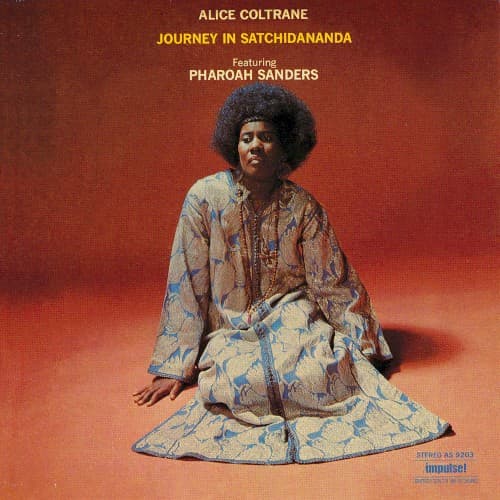
The albums that followed established her as a visionary in her own right. Huntington Ashram Monastery from 1969 introduced the harp as a lead instrument in free jazz contexts. Ptah, the El Daoud that same year balanced accessible modal jazz with moments of startling abstraction. Then came Journey in Satchidananda in 1971, her masterpiece and clearest statement of purpose. The title track opens with tamboura drone and builds slowly, Alice's harp dancing over the foundation while Sanders' soprano saxophone cries and soars. The album exists outside of time, neither nostalgic nor futuristic, simply present. Critics initially struggled with it, but decades later it stands as essential spiritual jazz, influential on ambient music, new age, and contemporary jazz alike.
Throughout the 1970s, Alice released a string of albums on Impulse! that explored similar territory with varying approaches. World Galaxy featured orchestral arrangements. Lord of Lords incorporated pipe organ and gospel choirs. Radha-Krsna Nama Sankirtana was pure devotional music, chanting and harmonium with minimal jazz elements. Commercial indifference met most of these releases. The jazz audience had moved on to fusion's electric excitement or the neo-conservative return to bebop. Alice's music fit neither trend.
In 1975, she underwent a spiritual transformation, becoming a guru in the Vedantic tradition and taking the name Swamini Turiyasangitananda. She established the Vedantic Center in Southern California and largely withdrew from public performance. For the next two decades, she focused on teaching, leading devotional services, and recording cassettes of ashram music distributed only to students and followers. These cassettes — eventually compiled and released as The Ecstatic Music of Alice Coltrane Turiyasangitananda — revealed yet another evolution, stripping away jazz improvisation in favor of devotional singing backed by synthesizers and organ. The music sounds utterly sincere, uninterested in commercial appeal or critical reception.
A quiet resurgence began in the early 2000s. Translinear Light in 2004 marked her return to jazz recording, featuring her sons on saxophone and drums alongside veteran collaborators. The music retained her spiritual focus but reconnected with jazz tradition more directly. Her final album, 2007's Translinear Light, appeared shortly before her death from respiratory failure. The comeback felt less like an artist chasing relevance and more like a master completing unfinished work, offering final transmissions to those who had been listening all along.
How Alice Coltrane's Vision Shaped Generations Beyond Jazz
Alice Coltrane's influence operates on multiple levels, some obvious and others still unfolding. Within jazz, she legitimized spiritual practice as compositional method, proving that devotional music could achieve artistic sophistication without compromise. Saxophonist Kamasi Washington, harpist Brandee Younger, and the entire Los Angeles creative music community acknowledge her as an ancestor. Her use of harp opened possibilities that continue to be explored — the instrument is no longer exotic in jazz contexts, and that normalization traces directly to her pioneering work.
Beyond jazz, her impact spreads wider. Electronic musicians and producers discovered her catalog in the 2000s, sampling her harp flourishes and repurposing her drones for hip-hop and ambient productions. Flying Lotus, her grandnephew, carries forward her experimental spirit in beat music and electronica, explicitly citing her as an influence. The ashram recordings found new audiences through reissues by David Byrne's Luaka Bop label, introducing her devotional period to listeners who might never encounter her Impulse! albums.
Cultural reassessment continues. Early critics dismissed her as derivative of her husband or indulgent in her spiritual obsessions. Contemporary scholarship recognizes her as an artist who operated with complete conviction, following an inner vision regardless of industry trends or audience expectations. Her career models an alternative to conventional success — she prioritized spiritual growth over commercial viability, community over fame, and left behind a body of work that feels increasingly relevant as jazz absorbs global influences and contemplative practices.
The music itself remains potent, particularly for listeners seeking jazz that transcends entertainment. Journey in Satchidananda still sounds like nothing else, a portal to states of consciousness that most music doesn't attempt to access. Her example — that jazz could be devotional, that improvisation could serve spiritual rather than virtuosic ends, that an artist could walk away from the spotlight and return on their own terms — continues to inspire musicians who refuse to separate their art from their inner lives.