
Stephen Bruner's Journey from Session Player to Genre-Defying Visionary
Stephen Lee Bruner operates under the name Thundercat with a six-string bass that bends between dimensions. Born in 1984 and raised in Los Angeles, he emerged from a musical family—his brother Ronald Bruner Jr. drums, his father sings—but his path carved something entirely new within jazz's modern landscape. By his early twenties, Bruner had already logged serious hours in thrash metal band Suicidal Tendencies, an apprenticeship that taught him velocity and aggression before he redirected that energy into something far stranger and more intricate.
What separates Thundercat from the jazz fusion revivalists is his refusal to treat the past as museum material. He absorbed Jaco Pastorius's harmonic language and Stanley Clarke's melodic sense, then filtered it through PlayStation soundtracks, anime culture, and the textural experimentation of Los Angeles beat scene producer Flying Lotus. His 2011 debut The Golden Age of Apocalypse arrived without precedent—bass-driven compositions that felt simultaneously like lost Weather Report sessions and transmissions from a cartoon future. The music industry didn't quite know where to file him, which became his greatest asset.
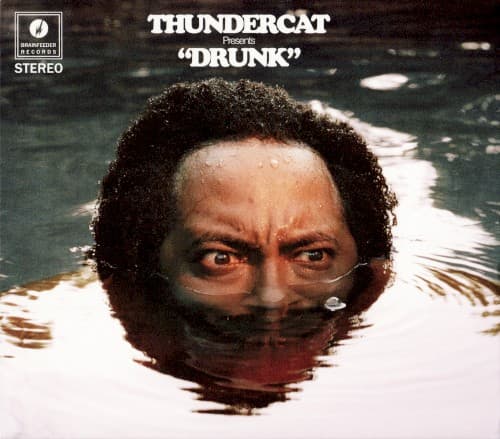
By the time Drunk landed in 2017, Thundercat had become an essential collaborator for Kendrick Lamar's To Pimp a Butterfly and a nexus point for musicians seeking to escape genre confinement. His profile pieces rarely capture the actual experience of his music: bass lines that move like schools of fish, chord progressions that seem to phase through walls, and a vocal approach that treats vulnerability and absurdism as compatible states. He's built a career on making the virtuosic sound playful and the silly sound profound.
Six-String Architecture: Thundercat's Harmonic and Rhythmic Language
Thundercat's sonic signature lives in the space between notes—the microtonal bends, the gliding transitions, the way a chord dissolves before you've fully processed it. His six-string bass functions less as a rhythm instrument and more as a polyphonic universe, capable of bass lines, chord voicings, and lead melodies simultaneously. The technical foundation comes from jazz fusion's golden era, but the harmonic choices reference everything from Brazilian bossa nova to video game midi files. On tracks like "Them Changes," the bass plays a repeating motif that's simultaneously the hook, the bassline, and the emotional core—a trick that shouldn't work but becomes hypnotic through sheer commitment.
His vocal delivery operates as an extension of the bass rather than a contrast to it. The voice stays high and breathy, often multi-tracked into candy-colored harmonies that recall Stevie Wonder's gentler moments or the Japanese city-pop records that influenced his generation of LA musicians. He doesn't belt or showboat vocally; instead, he lets the voice float above the instrumental complexity like a thought bubble. The effect creates intimacy within dense arrangements—you feel like he's singing directly into your ear even when the bass is executing impossible runs underneath.
Production-wise, Thundercat gravitates toward collaborators who understand negative space. Flying Lotus, his most frequent production partner, knows when to let the bass breathe and when to surround it with synthesizer atmospheres and fractured beats. The drum programming often nods to fusion's technical chops—complex time signatures, sudden tempo shifts—but rendered through software rather than live kits, creating a digital-organic hybrid that defines contemporary jazz's sonic palette. Even at his most experimental, Thundercat maintains melodic clarity; the songs may wander through harmonic labyrinths, but they always give you something to hum.
From Suicidal Tendencies to Jazz Vanguard: Thundercat's Unlikely Trajectory
Bruner's early career reads like preparation for a role that didn't exist yet. His teenage years in Suicidal Tendencies—playing crossover thrash with hardcore punk veterans—gave him the technical stamina and stage presence that most jazz conservatory students never develop. Those tours taught him how to hold an audience's attention, how to make virtuosity entertaining rather than academic. When he left that world in his mid-twenties, he'd already internalized a fundamental truth: chops mean nothing if the music doesn't move people.
The breakthrough came through friendship and geography. Los Angeles in the late 2000s had become an incubator for musicians rejecting the industry's genre boundaries. Producer Flying Lotus was building Brainfeeder Records as a home for exactly this kind of unclassifiable music, and Bruner's 2011 debut The Golden Age of Apocalypse introduced Thundercat as a fully formed artistic statement. The album played like a fever dream—songs about death and relationships rendered through jazz fusion structures and electronic production. Critics didn't quite know how to contextualize it; was this jazz, funk, electronic music, or something entirely new? The ambiguity became the point.
Apocalypse and its 2013 follow-up Apocalypse Meow established Thundercat's creative vocabulary, but 2015's The Beyond / Where the Giants Roam EP showed exponential growth. The six-track release felt more focused, the compositions tighter, the emotional stakes higher. By this point, Bruner had become Kendrick Lamar's secret weapon, contributing bass and arrangements to To Pimp a Butterfly's jazz-funk framework. That collaboration exposed him to millions of listeners who'd never heard of Brainfeeder, suddenly making his own experimental work seem less niche and more like the future.
Drunk arrived in February 2017 as Thundercat's most ambitious and personal statement. Twenty-three tracks across fifty-four minutes, the album cycled through grief, addiction, friendship, and anime references with equal sincerity. Bruner had lost his close friend Mac Miller, and that loss permeates the album's undercurrent even as the surface stays playful. Tracks like "Show You the Way" brought in Kenny Loggins and Michael McDonald—yacht rock icons—alongside Flying Lotus, creating a multigenerational conversation about California soft rock and fusion. "Them Changes" became something close to a hit, its bass line lodging in cultural memory the way Jaco's "Portrait of Tracy" did for an earlier generation.
The album's structure reflected Bruner's actual listening habits: short attention spans, sudden tonal shifts, deep dives into emotion followed by cartoon sound effects. Drunk scored a 7.3 in our review, and while some found its scatter-shot approach frustrating, others recognized it as an honest portrait of consciousness in the streaming era. It earned Thundercat a Grammy nomination and solidified his position as someone who could collaborate with anyone—from Erykah Badu to Childish Gambino to Kamasi Washington—without diluting his sonic identity.
Post-Drunk, Thundercat has continued expanding his reach without compromising his core strangeness. His 2020 album It Is What It Is won a Grammy for Best Progressive R&B Album, a category that barely existed before artists like him forced the industry to create new containers. He's become the bassist other musicians call when they want to signal artistic ambition—appearing on projects by SZA, Louis Cole, and dozens of others. Yet his solo work remains defiantly weird, resistant to the smoothing-out that often accompanies mainstream recognition.
Redefining Jazz Bass for the Digital Age: Thundercat's Lasting Impact
Thundercat's influence operates on two levels: technical and cultural. On the technical side, he's inspired a generation of bassists to stop thinking of their instrument as merely rhythmic support. His approach—treating the bass as capable of anything a piano, guitar, or synthesizer can do—has become a model for young players who grew up with genre as a fluid concept rather than a rigid boundary. Music schools now teach his compositions, and his harmonic vocabulary has entered the standard language of contemporary jazz and R&B.
Culturally, Thundercat represents something larger: the integration of so-called "low" culture into jazz's traditionally highbrow space. He name-drops Dragon Ball Z and Captain Murphy with the same reverence previous generations reserved for Coltrane and Mingus. This isn't dumbing down—it's an expansion of what's considered worthy of artistic exploration. By refusing to segregate his influences into respectable and disposable categories, he's helped reshape jazz as a living, inclusive tradition rather than a museum practice. His work bridges the Brainfeeder beat scene, the jazz establishment, and hip-hop's experimental wing, proving these supposedly separate worlds share more DNA than the industry's categorization system suggests.
His collaborative presence has elevated entire albums. Without Thundercat's bass work, Kendrick Lamar's To Pimp a Butterfly would sound fundamentally different—less rooted in the jazz fusion tradition that connects it to Miles Davis's electric period. His contributions don't just add color; they provide structural integrity. As the jazz world continues grappling with relevance and accessibility, Thundercat offers a template: stay virtuosic, stay weird, and trust that audiences will meet you where you are if the music is honest enough.