Style & Context
Influences
African ceremonial art, psychedelic poster design, Afrofuturism, Sun Ra cosmic imagery
Location
The African aesthetic reclaimed Black cultural roots during the Black Power era while synthesizers represented urban technological access and future-facing ambition.
Visual Language
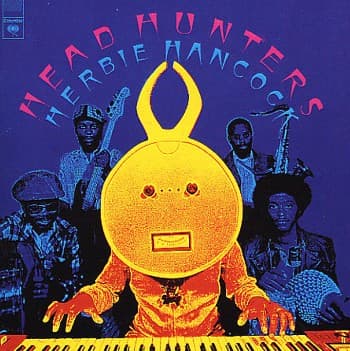
The duotone blue wash over photographic musicians contrasts sharply with the illustrated yellow being, creating deliberate visual dissonance that mirrors fusion's genre collision.
Symbols
Glowing humanoid figure
The radiant being represents technology channeling ancestral wisdom into future sound through synthesizers and electric instruments.
Four shadowed musicians
The quartet of traditional-dressed figures connects Hancock's electronic experimentation to African musical heritage and ceremonial performance roots.
Yellow keyboard hands
The illuminated hands touching keys symbolize the human touch transforming cold electronics into warm, funky, spiritually alive music.
Where Sound Meets Image
The solar-powered being visualizes how Hancock's Moog and clavinet sounds pulse with organic warmth despite electronic origins, matching tracks like Chameleon where synthesizer basslines groove like living creatures. The four witnessing musicians mirror the tight quartet format exploring modal funk over traditional jazz structures. The blue-to-yellow temperature shift reflects the album's balance between cool modal jazz foundations and hot funk rhythms that made it jazz's best-selling album for decades.
This cover established Afrofuturism as visual language for jazz's electronic transformation, directly influencing Miles Davis's dark period imagery and every fusion cover balancing tradition with technology. The bold illustrative approach freed jazz album art from documentary photography's dominance, proving abstract concepts could sell complex music to funk audiences.