The scorecard
8.8/10 · Essential
- Composition20%
- 9.0
- Recording15%
- 7.5
- Performance30%
- 9.5
- Cohesion15%
- 8.0
- Originality10%
- 10.0
- Replay value10%
- 8.5
Themes like "Lonely Woman" and "Peace" are lean melodic statements that give the players vivid material to depart from and return to, creating frameworks that invite rather than dictate.
Radio Recorders captured the quartet with enough presence to hear the plastic Grafton's bite and Haden's dirge-like pulse, though the balance occasionally buries Cherry's cornet behind Coleman's attack.
Coleman and Cherry bend pitch and phrase with a spontaneity that still sounds urgent decades later, while Haden and Higgins provide both anchor and friction in the rhythm section's push-pull interplay.
Six tracks at roughly five to nine minutes each, all built on the same head-solo-head structure, create a consistent formal arc but also a certain sameness in the middle stretch.
Coleman's pianoless quartet, microtonal phrasing and abandonment of chord changes made this a foundational free jazz statement with no precedent in 1959.
The emotional directness of "Lonely Woman" and the melodic logic beneath the surface complexity reward return listens, though the unvarying format asks for patience across the full runtime.
Ornette Coleman The Shape of Jazz to Come — What Happens When the Chords Disappear
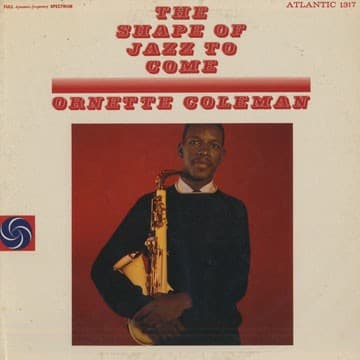
The thesis is in the first ten seconds of the opening track. Charlie Haden plays a slow bass ostinato, Billy Higgins answers with fast cymbal work, and then Ornette Coleman and Don Cherry state the melody of "Lonely Woman" in unison, bending pitches and wailing with an emotional nakedness that makes the absence of a piano suddenly feel like necessity rather than gimmick. The Shape of Jazz to Come, recorded in a single May 1959 session at Radio Recorders in Hollywood, is the album where Coleman's decade of working out an alternative to chord-based improvisation reached its clearest and most cohesive form. Atlantic producer Nesuhi Ertegun wanted the title to signal uniqueness to consumers, and the claim was earned: no jazz quartet in 1959 sounded like this, and the pianoless format, plastic Grafton alto saxophone, microtonal phrasing and abandonment of harmonic accompaniment announced a path forward that much of the avant-garde would follow.
Coleman had spent the previous eleven years moving between Fort Worth, New Orleans and Los Angeles, developing his sound while working as an elevator operator and studying music theory on his own terms. By the time bassist Percy Heath and pianist John Lewis of the Modern Jazz Quartet brought him to the Lenox School of Jazz in Massachusetts earlier in 1959, Coleman and cornetist Don Cherry were accomplished players whose presence at the school generated friction and buzz in equal measure. Lewis secured Coleman's Atlantic deal and booked him at the Monterey Jazz Festival, setting the stage for this debut on the label. The question the album answers is whether Coleman's melodic approach could sustain an entire record without the harmonic scaffolding that bebop and hard bop relied on. It does, but the consistency of the format also reveals the limits of the method at this early stage.
Melody Without a Map, Rhythm Without a Cage
Coleman coined the term "harmolodic" to describe his philosophy: a fusion of harmony, movement and melody that privileges the melodic line over chord changes. On The Shape of Jazz to Come, that philosophy is audible in every track. Each composition follows a simple head-solo-head structure, familiar from bebop, but the solos abandon chord progressions entirely. Coleman and Cherry improvise on the emotion and contour of the theme rather than on a sequence of harmonies, and the results feel both liberated and unmoored. When Coleman solos on "Eventually," he departs so far from the theme that a listener expecting harmonic logic might think he has moved to a different piece, but the melodic and emotional continuity holds the performance together when he and Cherry return to restate the head.
The quartet's instrumentation is central to the sound. With no piano or guitar to outline chords, Haden and Higgins become the only harmonic and rhythmic reference points, and both play with unusual freedom. Haden often walks a pulse that is more dirge than swing, especially on "Lonely Woman," while Higgins pairs slow tempos with fast cymbal patterns, creating a rhythmic dislocation that gives the horns room to phrase across the beat rather than on top of it. Coleman played a plastic Grafton alto saxophone, a choice that contributed a harsh, reedy timbre distinct from the warmer sound of brass instruments favored by bebop players. That timbre, combined with his use of microtonal intervals—pitches bent slightly sharp or flat of equal temperament—gives his lines a vocal quality, as if he is singing through the horn rather than executing a technical run.
Don Cherry's cornet work is the album's underappreciated strength. He matches Coleman's phrasing and pitch-bending with a delicacy that softens the alto's attack, and his solos on tracks like "Congeniality" show a melodic inventiveness that complements rather than duplicates Coleman's approach. The recording, engineered at Radio Recorders, captures the quartet with enough presence to hear the details of Haden's bass and the bite of Coleman's plastic horn, though the balance occasionally buries Cherry's cornet in the mix when both horns play together.
The album's weakness is formal rather than performative. All six tracks follow the same structure—theme, solos, theme—and while the themes themselves are varied, the sameness of the format creates a plateau in the middle of the record. "Focus on Sanity" and "Congeniality" are strong performances, but they do not add new information after the first three tracks have established the quartet's methods. The lack of dynamic contrast across the sequencing makes the album feel longer than its thirty-seven minutes, and a listener waiting for the quartet to shift approach or introduce a new formal idea will be disappointed. Coleman was still working out what his harmolodic philosophy could do, and at this stage it could do one thing very well.
A Record Front-Loaded With Its Argument
The album peaks early and sustains rather than builds. The opening stretch is the strongest and the clearest argument for Coleman's method: the slow-fast rhythm section pairing, the sorrowful melodies, and the solos that wander far from the theme but return with emotional logic all demonstrate what the pianoless quartet can accomplish. The first half extends the argument, with some performances stretching past nine minutes and giving all four players extended solo space. By the time the back half begins, the method is established, and the remaining material feels like variations on the template rather than developments of it.
The sequencing does no favors to the shorter, breezier compositions. The more playful themes arrive late in the running order when the format's limitations are already apparent. The closing stretch offers solid solos, but it does not build to a conclusion or offer a final statement; it simply ends. The lack of a climax or a shift in texture across the six performances makes the album feel more like a strong demo of a new idea than a fully realized artistic statement. Coleman would refine and expand the approach on subsequent records, but here the format's consistency works against the music's emotional range.
The Blueprint That Opened the Door, Not the Cathedral Beyond It
The Shape of Jazz to Come is a foundational free jazz album and a necessary listen for anyone interested in how improvisation moved beyond chord changes, but it is not Coleman's deepest or most varied work. It ranks as his most historically significant statement and one of the clearest early arguments for what became the free jazz movement, but the sameness of the format and the lack of dynamic contrast across the sequencing keep it from being an all-time peak in his catalog. The emotional directness of "Lonely Woman" and the quartet's interplay throughout reward repeated listens, and the melodic logic beneath the surface complexity reveals itself over time, but the album asks for patience in the middle stretch where the tracks begin to blur together.
This is the album for listeners who want to understand where free jazz began and what it sounded like before the movement splintered into noise and texture experiments. It is also the album for listeners who have heard later avant-garde records and want to hear the clearer, more melodic blueprint that preceded them. Listeners who prefer the denser, more abrasive later work of Coleman's career or the full-band approach of Free Jazz: A Collective Improvisation should start elsewhere. Begin with "Lonely Woman," then move to "Peace" to hear the quartet sustain the method across a longer performance. If those two tracks hold your attention, the rest of the album will make sense. After this, hear Change of the Century, recorded seven months later with the same quartet, which refines the approach and adds more variety to the sequencing, or move forward to Free Jazz to hear Coleman push the method toward collective improvisation and denser textures.
Track by track
Track Listing
Lonely Woman
StandoutThe album's lone standard and its emotional center. Haden's slow, dirge-like bass line opens the track, followed by Higgins' fast cymbal work, creating a rhythmic dislocation that was unusual in 1959 and remains striking today. Coleman and Cherry state the melody in unison, bending pitches and phrasing with a nakedness that Fred Kaplan described as raising shivers a half century later. Coleman's solo departs from the theme's harmonic implications entirely, improvising instead on the emotion and contour of the melody, and the other players follow suit. The performance coheres because the emotional through-line is clear, and when the quartet returns to the theme at the end, the arrival feels earned rather than formulaic. Coleman wrote the piece in the early 1950s after seeing a photograph of a wealthy but sorrowful woman in a Los Angeles gallery, and the image's contrast between material comfort and inner sadness translates directly into the music's slow-fast rhythmic tension and the melody's wailing, microtonal phrases. The track is the album's strongest argument for what a pianoless quartet improvising without chord changes can accomplish, and it remains the most emotionally direct performance on the record.
Eventually
StandoutA mid-tempo head with a lighter melodic contour than the opener. Coleman's solo wanders far from the theme, to the point where a listener expecting harmonic continuity might lose the thread, but the melodic and emotional logic holds the performance together. Cherry's cornet solo is more playful, with bent pitches and rhythmic displacements that complement Coleman's approach without duplicating it. Haden and Higgins provide a steady but flexible pulse, and the rhythm section's ability to shift the feel without locking into a rigid tempo gives the horns space to phrase freely. The track demonstrates the quartet's interplay and the harmolodic method's capacity for variety within a single performance, though it does not add new formal information after "Lonely Woman" has already established the approach.
Peace
SolidThe longest track on the album at just over nine minutes, and the first test of whether the quartet's format can sustain an extended performance. The theme is slower and more meditative than the previous two tracks, and the solos stretch out accordingly. Coleman's alto solo explores microtonal intervals and rhythmic displacement across several choruses, and Cherry's cornet response is more delicate, softening the attack and offering a melodic counterpoint to Coleman's harsher timbre. Haden takes a brief bass solo that walks a line between pulse and melody, and Higgins' cymbal work creates a shifting rhythmic foundation that never settles into a predictable groove. The length reveals both the strengths and the limits of the method: the emotional and melodic continuity holds across the nine minutes, but the lack of harmonic or formal development means the track plateaus rather than builds. It is a strong performance that rewards close listening, but it also signals that the quartet will need to expand its toolkit to sustain full-length statements without repetition.
Focus on Sanity
SolidThe opening track of side two, originally Coleman's preferred title for the entire album. The theme is more rhythmically jagged than the first three tracks, with angular phrasing and abrupt stops that give the performance a more disjointed feel. Coleman and Cherry solo with the same microtonal bending and melodic logic as earlier, but the track does not add new formal or emotional information after the first side has already established the quartet's methods. The rhythm section maintains the flexible pulse and slow-fast dynamic that characterizes the album, but the performance feels like a variation on the template rather than a development of it. Solid playing throughout, but the sameness of the structure begins to work against the music by this point in the running order.
Congeniality
StandoutA more playful theme with a brighter melodic contour, offering some relief from the album's darker emotional palette. Cherry's cornet solo is particularly strong here, with bent pitches and rhythmic displacements that show his melodic inventiveness. Coleman's solo is more aggressive, with harsher timbre and more abrupt phrasing, and the contrast between the two horns gives the track more dynamic range than some of the earlier performances. Haden and Higgins play with the same freedom as before, and the rhythm section's flexibility remains the quartet's rhythmic and harmonic anchor in the absence of a chordal instrument. The track is well-played and the theme is memorable, but it arrives late in the running order when the format's limitations are already apparent, and it does not shift the album's approach or add a climax to the sequencing.
Chronology
SolidThe album's closer, a mid-tempo head with a theme that is more straightforward than some of the earlier compositions. Coleman and Cherry state the melody cleanly, and the solos follow the same pattern as the rest of the record: melodic improvisation without harmonic scaffolding, microtonal bending, and a return to the theme at the end. The performance is solid but unremarkable, and it does not offer a final statement or a climax to close the album. It simply ends, leaving the listener with the sense that the quartet has demonstrated its method across six tracks but has not yet found a way to build or resolve across the length of a full record. A competent performance that reinforces the album's thesis without adding new information.