The Voice That Shaped American Popular Music
Frank Sinatra didn't just sing jazz standards — he transformed how the entire culture understood what a voice could accomplish. Born in Hoboken, New Jersey, in 1915, Sinatra emerged from the big band era as a skinny kid with Tommy Dorsey's orchestra, then spent six decades proving that popular singing could carry the emotional sophistication of any art form. By the time he died in 1998, he had fundamentally altered the relationship between singer, song, and audience.
What separated Sinatra from his contemporaries wasn't range or power but interpretive intelligence. He approached lyrics like a method actor approaches dialogue, finding motivation in every line, shading every phrase with psychological nuance. He made you believe he'd lived through whatever story the song told, whether he had or not. That commitment to emotional truth, combined with impeccable timing and a conversational delivery that seemed effortless, established a template every subsequent vocalist has had to reckon with.
His influence extends far beyond jazz circles into the entire architecture of 20th-century American entertainment. Sinatra bridged swing and modern jazz, big band spectacle and intimate balladry, the recording studio and the concert stage. He turned albums into coherent artistic statements years before rock musicians claimed to invent the concept. He built a persona so culturally dominant that "Ol' Blue Eyes" became shorthand for a certain vision of American masculinity, sophistication, and style that still resonates today.
Phrasing as Architecture: Sinatra's Vocal Jazz Approach
Sinatra treated rhythm the way a great horn player does. He learned phrasing from watching Tommy Dorsey's trombone technique — the long, sustained lines that seemed to breathe without breaking — and applied that instrumental sensibility to vocal delivery. He'd lag behind the beat for emotional weight, rush slightly ahead to build tension, or land exactly on time when precision served the lyric. This rhythmic flexibility meant he never sounded locked to the arrangement; he danced around it, treating the orchestra as a conversation partner rather than a backing track.
His tonal palette shifted with his intention. The early Dorsey years showcased a lighter, sweeter sound aimed at bobby-soxers. The Capitol Records period from the 1950s — his artistic peak — revealed a darker, more textured instrument capable of aching vulnerability on ballads and swinging authority on uptempo numbers. By the Reprise era, a slight rasp and harder edge entered his voice, adding world-weariness that suited his repertoire of saloon songs and late-night reflections. Each phase sounded like the man living through it.
The sophistication came through song selection and arrangement. Working with Nelson Riddle, Billy May, and Gordon Jenkins, Sinatra pioneered the concept album in popular music, sequencing songs to create mood and narrative arc. He understood that great singing isn't about displaying vocal athleticism but serving the emotional truth of the material. A Sinatra performance feels like confession, seduction, or philosophical musing depending on the tune, but always sounds like genuine human experience rather than technical exhibition.
From Hoboken to Capitol: Sinatra's Career Trajectory
The arc runs from singing waiter to the most powerful entertainer in America, but the path wasn't smooth. Sinatra's early fame came as the skinny kid who made teenage girls faint at the Paramount Theatre in the early 1940s. Those Columbia Records years established him as a pop idol, but the material often leaned lightweight, the arrangements sometimes saccharine. When his voice faltered and his popularity crashed in the late 1940s, the industry wrote him off.
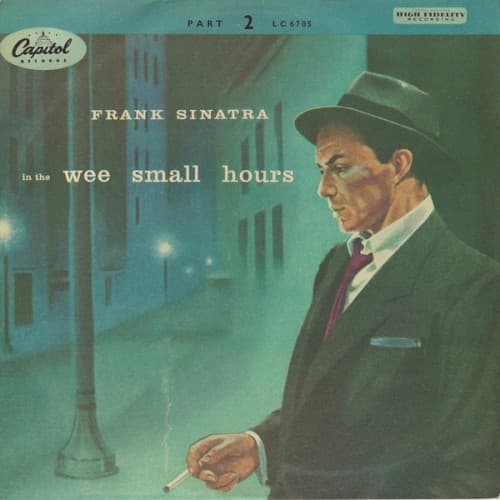
The comeback defined him. Signing with Capitol Records in 1953 gave Sinatra two crucial elements: creative control and Nelson Riddle. Their collaboration produced a run of concept albums that remain the gold standard for vocal jazz: "Songs for Young Lovers," "Swing Easy!," "In the Wee Small Hours." That last one, recorded in 1955 during the dissolution of his marriage to Ava Gardner, stands as the first true concept album in popular music — a sustained meditation on loneliness and loss that proved popular music could achieve artistic coherence. The emotional rawness Sinatra brought to those sessions transformed him from a pop singer into an artist.
The Capitol period from 1953 to 1961 represents his creative zenith. Albums like "Songs for Swingin' Lovers!" and "Only the Lonely" showcased his range: one moment the epitome of confident swagger, the next moment exposing profound vulnerability. He worked with arrangers who understood jazz harmony and orchestral color, creating settings that elevated the material without overwhelming the voice. These weren't just collections of singles; they were unified artistic statements designed to be experienced as complete works.
Launching Reprise Records in 1960 made Sinatra one of the first artists to own his master recordings and control his creative destiny. The move influenced how subsequent generations thought about artistic ownership and industry power. His Reprise output maintained high standards even as popular taste shifted toward rock and soul. He recorded with Count Basie, explored bossa nova, tackled ambitious projects like "Watertown," and continued refining his interpretive approach. The quality remained remarkably consistent even as the cultural landscape changed around him.
By the 1970s and beyond, Sinatra had become an institution, performing for presidents and mob bosses, embodying a certain vision of old-school entertainment values. The voice coarsened, the phrasing occasionally grew more mannered, but the essential intelligence remained. His final recordings in the 1990s showed an artist still committed to the craft of interpretation, still finding new shadings in songs he'd sung for decades.