The scorecard
8.9/10 · Essential
- Composition20%
- 9.0
- Recording15%
- 8.5
- Performance30%
- 9.5
- Cohesion15%
- 8.0
- Originality10%
- 8.5
- Replay value10%
- 9.0
Eight standards chosen for sustained minor-key melancholy, each arrangement stripping the rhythm section back to serve the lyric.
Nelson Riddle's sparse orchestrations place Sinatra's voice in an intimate room with strings that echo rather than cushion.
Sinatra sings entire phrases on the breath, bending pitch and rhythm to make heartbreak sound like ordinary conversation.
Eight songs hold a single mood without variation, which is the point but makes the second half feel longer than the first.
The concept album as a form was new in 1955, and the decision to record ballads at this tempo for forty minutes straight had no jazz or pop precedent.
The performances reward close listening but the unbroken mood means you need to be in the right frame to start it.
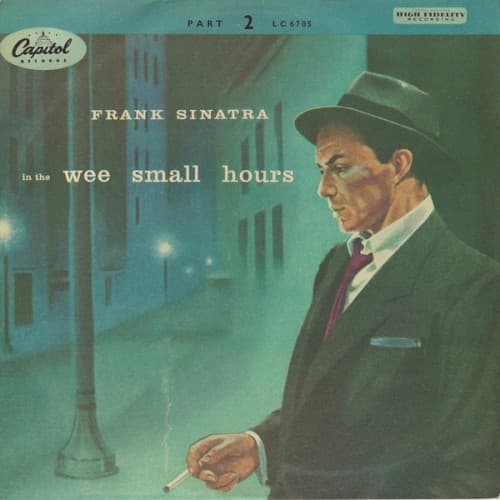
Frank Sinatra In the Wee Small Hours, Part 2 — Eight Ballads at One Tempo, No Relief
The second disc of In the Wee Small Hours makes no concessions. Where the first half of the album opened with faster numbers to ease the listener in, Part 2 commits to the same slow, after-hours tempo for all eight tracks. The thesis is that heartbreak is not a single moment but a state you inhabit, and Sinatra and arranger Nelson Riddle build an album that lives in that state without looking for an exit. The question is whether forty minutes of unbroken melancholy at this tempo is an artistic achievement or an endurance test.
The answer depends on what you want from a vocal album. If the goal is phrasing, breath control and the ability to make a standard sound like a private confession, Part 2 delivers some of the best singing Sinatra recorded in the 1950s. If the goal is variety or momentum, the album offers almost none. The arrangements are spare, the strings are placed low in the mix, and the rhythm section does little more than mark time. Sinatra sings entire verses on a single breath, bending notes and delaying resolutions so that each phrase sounds conversational rather than performed. The material is all standards, most of them already recorded by other singers, but the interpretations are specific enough that the songs feel like they were written for this exact album. The risk is that eight ballads at this tempo, with no uptempo track or instrumental break to shift the mood, will feel longer than the running time. The album earns that risk but does not eliminate it.
Strings That Echo, Not Cushion
Nelson Riddle's arrangements are the structure that makes the sustained mood possible. The strings enter after the vocal line rather than underneath it, so each phrase Sinatra sings lands in near-silence before the orchestra responds. The effect is that the voice sounds close and unprotected, as if recorded in a small room rather than a studio. The rhythm section is mixed so low that on several tracks it is barely audible, which removes the swing feel that would have made the songs sound like jazz performances rather than something closer to art song.
The tempos are uniform. Every track on Part 2 sits at roughly the same ballad pace, which means the album rises and falls only through dynamics and phrasing, not through rhythm or key changes. "What Is This Thing Called Love?" opens the disc with Riddle's string introduction, and the tempo it establishes is the tempo that carries through to the final track. The decision to avoid modulation or tempo shifts within songs is deliberate: these are not arrangements that build to a climax but ones that sustain a single emotional line from the first bar to the last. The strings swell occasionally but never take over, and there are no instrumental solos to break up the vocal focus.
The weakness is monotony. By the sixth track the listener knows exactly what the next arrangement will sound like, and the lack of contrast makes the individual songs harder to distinguish on first listen. The choice of standards mitigates this to some degree—each song has a different melodic shape and harmonic progression—but the interpretive approach is so consistent that the album can feel like eight variations on the same performance rather than eight separate statements. The uniformity is the concept, but it is also the limitation. An uptempo track or an instrumental interlude would have given the ear a place to rest, and the absence of either makes the second half of the album feel longer than it is.
A Sequence Without Peaks or Valleys
The album is front-loaded in the sense that the first three tracks are the strongest performances, but there is no arc. "What Is This Thing Called Love?" and "Last Night When We Were Young" set the tone, and the remaining six tracks maintain it without building toward a climax or resolution. The sequencing is careful—each song ends quietly, and the next begins in the same mood—but the result is that the album feels like a single forty-minute piece rather than a collection of discrete tracks.
"I'll Be Around" and "Ill Wind" sit in the middle of the disc and are the least memorable performances, not because the singing is weaker but because the arrangements offer nothing to distinguish them from the tracks on either side. By the time the album reaches "Dancing on the Ceiling" and "I'll Never Be the Same," the listener has heard seven ballads in the same key and tempo, and even strong phrasing cannot fully compensate for the lack of variety. The final track, "This Love of Mine," ends the album on the same note it began, which is thematically appropriate but leaves no sense of resolution. The album simply stops rather than concludes.
A Concept Carried to Its Logical End
In the Wee Small Hours, Part 2 is the more difficult half of the album, and the one that makes the strongest case for Sinatra as an interpreter rather than a stylist. The singing is as good as anything he recorded in the 1950s, and the arrangements are engineered to foreground the voice at the expense of everything else. The album works best as a late-night listen when the mood matches the material, and it rewards attention to phrasing and breath control in a way that few vocal jazz albums do. The problem is that it offers no relief, and listeners who are not in the exact frame of mind the album assumes will find it slow and samey.
This is not the album to start with if you are new to Sinatra's ballad work. The first disc of In the Wee Small Hours includes faster tracks and more varied arrangements, and it makes a better introduction to the concept. Part 2 is for listeners who already know they want forty minutes of slow, orchestrated heartbreak and are willing to meet the album on its terms. The best tracks are "What Is This Thing Called Love?," "Last Night When We Were Young," and "This Love of Mine," all of which highlight the phrasing and control that make the album worth hearing. If you want to hear where Sinatra's ballad style leads when taken to its furthest point, this is the album. If you want variety or momentum, skip it and listen to the full LP instead, where the sequencing spreads the slow material across two discs and gives the ear more room to breathe.
Track by track
Track Listing
What Is This Thing Called Love?
StandoutRiddle's string introduction is the template for the entire disc: a slow, sustained line that establishes the tempo and the mood before Sinatra enters. The vocal phrasing is conversational, with Sinatra bending the melody to make the question in the title sound genuine rather than rhetorical. The rhythm section is almost inaudible, which places all the weight on the voice and the strings. The arrangement avoids the swing feel the song usually gets in faster versions, and the result is that the performance sounds less like a jazz standard and more like a ballad written for this exact setting. It is the strongest track on Part 2 and sets an interpretive standard the rest of the album struggles to match.
Last Night When We Were Young
StandoutSinatra sings the verse on a single breath, delaying the resolution of the final phrase so that it hangs in the air before the strings respond. The lyric is sentimental, but the delivery is restrained enough that the sentiment feels earned. Riddle's arrangement keeps the orchestra low in the mix and uses the strings to echo the vocal line rather than support it. The tempo is slightly slower than the opening track, which makes the performance feel even more intimate. The weakness is that the melody is less distinctive than the Cole Porter standard that precedes it, and the arrangement offers nothing to compensate.
I’ll Be Around
SolidThe vocal performance is strong, but the arrangement is identical in structure to the previous two tracks, and by this point the lack of variety is starting to register. Sinatra's phrasing is careful, and he finds small moments to bend the pitch or delay a resolution, but the song itself is not as interesting melodically as the first two standards, and the listener has now heard three ballads at the same tempo with no shift in mood or dynamics. Solid singing, forgettable arrangement.
Ill Wind
WeakThe weakest track on the disc. The melody is repetitive, and the arrangement does nothing to distinguish it from the three songs that precede it. Sinatra's phrasing is still precise, but the material does not give him much to work with, and the result is that the performance feels like a placeholder. The tempo is the same, the string voicings are the same, and the mood is the same. By the halfway point of Part 2 the concept is starting to feel like a limitation rather than a strength. This is filler.
It Never Entered My Mind
StandoutA Rodgers and Hart standard that benefits from a stronger melody than the previous two tracks. Sinatra sings the verse with enough restraint that the lyric's self-pity does not overwhelm the performance, and Riddle's arrangement gives the strings a more active role in the second half of the song, which provides some relief from the uniformity of the earlier tracks. The tempo is still slow, and the mood is still unrelieved melancholy, but the song itself is good enough that the performance holds attention. This is the best track since the opening two.
Dancing on the Ceiling
SolidRodgers and Hart again, but the melody is less distinctive than "It Never Entered My Mind," and the arrangement is back to the same sparse string voicings and inaudible rhythm section that define the rest of the disc. Sinatra's phrasing is careful, and he finds moments to bend the melody in ways that make the lyric feel personal, but the song does not offer enough material to distinguish it from the weaker tracks earlier in the sequence. Competent but unremarkable.
I’ll Never Be the Same
SolidAnother ballad at the same tempo, another sparse arrangement, another performance that showcases Sinatra's breath control and phrasing but offers nothing to break the monotony. The melody is serviceable, and the vocal performance is as good as anything else on the disc, but by the seventh track the lack of contrast is weighing on the album. The strings swell slightly in the final bars, which is the closest the disc comes to a dynamic shift, but it is not enough to give the track a sense of climax or resolution.
This Love of Mine
SolidThe album ends as it began, with a slow ballad and a sparse arrangement that places Sinatra's voice in the foreground and the orchestra in the background. The vocal performance is strong, and the phrasing in the final verse is among the best on the disc, but the song does not function as a closing statement so much as the point at which the album simply stops. There is no resolution, no shift in mood, no sense that the sequence has arrived anywhere. The concept is sustained to the end, which is admirable, but the result is that the listener is left in the same place they were forty minutes earlier, which may or may not be the point.